

EPDM Granules for Sports Surfaces: Material Selection, Costs and Applications in 2026
An EPDM sports surface is procured as a material package rather than as a finished product, which means the buying decision covers colored EPDM granules for the wear layer, PU binder for the base and top layer, base layer granules, and the packaging the material ships in.
EPDM granules are the part of that package buyers actually see and touch. The colored granule layer sets the surface texture, the color design and, to a large extent, how long the surface keeps its appearance outdoors. That is why granule selection deserves more attention than a line item on a bill of materials.
FieldsMaster manufactures and supplies EPDM granules and PU binder for sports and recreation surfacing. The company is a material producer rather than a surfacing contractor, so this guide is written from the material side: what to specify in the granule, how the granule pairs with the binder, and how both translate into a project quantity and quotation.
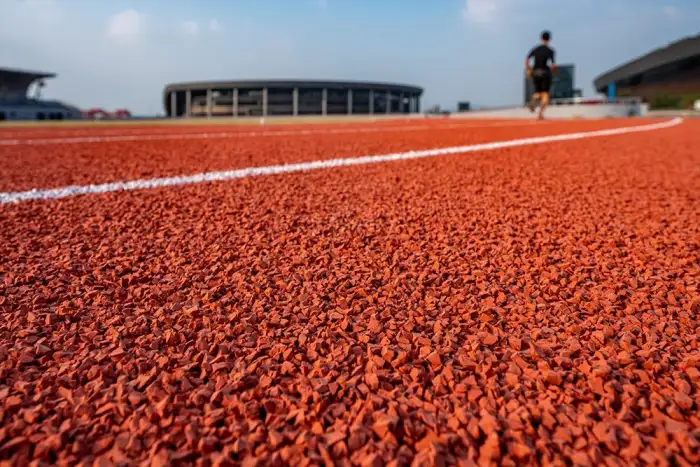
An EPDM sports surface is a poured or tiled rubber system made of EPDM granules plus PU binder over a stable base. Most outdoor projects are planned around 18-35 USD per square meter installed.
The granule layer is what determines color fastness and lifespan, which is why the rest of this guide starts there.
Below you will find what defines a sports-grade EPDM granule, how to specify particle size, color and formulation, how to match the granule with the right PU binder, where the material is used, typical cost structure, and how FieldsMaster converts project parameters into a granule and binder material list.
Key Takeaways
- EPDM granules are the product that decides the surface. The granule layer is the visible wear layer, and its sizing, color and formulation drive texture, color fastness and service life.
- Granules and binder are specified together. Particle size, color, formulation and the PU binder ratio belong in the same conversation, not in separate sections of a specification.
- FieldsMaster is a material supplier. EPDM granules and PU binder are manufactured and supplied as materials, so a quotation is built from granule and binder consumption rather than a lump-sum surfacing price.
- Granule price alone is a poor cost proxy. Compare total installed cost per square meter over the expected service life, including binder ratio, thickness and installation loss.
- Color stability must be verified, not assumed. Confirm it against the applicable standard for the project location using the test reference for the selected granule formulation.
1. EPDM Granules: What They Are and Why the Granule Layer Decides the Surface
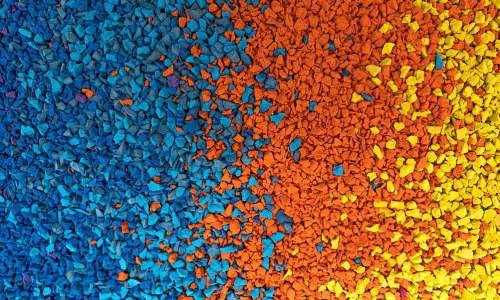
EPDM granules are colored rubber particles produced from EPDM (ethylene propylene diene monomer) rubber. In a sports surface they form the exposed top layer, mixed with PU binder and troweled or sprayed over a base. The granule is supplied as a bulk material, in a defined particle size range and a defined color, and it is the last thing the installer places on site.
Because the granule layer takes all of the UV exposure, foot traffic and abrasion, it is the layer that determines how the surface looks and behaves over time. A well-built base under a weak granule layer still ends up as a faded or discolored surface.
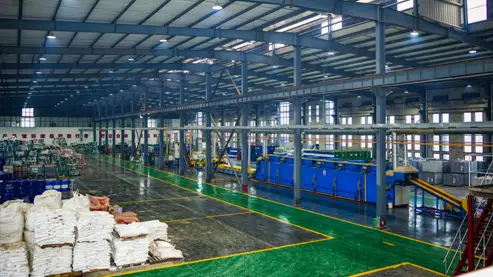
Granule quality is a manufacturing question before it is a project question. Colored EPDM granules are produced in batches, and the controls applied at the mixing, cutting and screening stages are what make a batch reproducible.
That is the reason a project should be able to trace the granule back to a production reference, not just to a catalog color. Read more in the general guide to EPDM granules quality, safety and standards.
1.1 Where EPDM Granules Sit in a Sports Surface System
A poured EPDM system normally has three parts. The granule is supplied for the third one, and the binder is supplied for both the base and the top layer.
- Base layer or underlayer: usually SBR rubber granules bonded with PU binder, designed to absorb impact and level the surface.
- PU binder layer: the adhesive system that bonds granules together and connects the surface to the base. FieldsMaster supplies this as a separate product alongside the granule.
- EPDM granule top layer: the colored EPDM granule wear layer providing UV resistance, color design, anti-slip texture and long-term surface durability.
The granule and the binder are the two materials that a granule manufacturer can actually control. Base construction, drainage and installation practice sit with the project team, which is why a granule supplier should be asked about the material and not only about the finished surface.
1.2 What a Sports-Grade EPDM Granule Should Deliver
- Controlled particle size range rather than an approximate grain, so the surface texture is repeatable between batches.
- Consistent color within a batch and across reorders, because an outdoor surface is judged on how evenly it ages.
- Formulation chosen for the exposure the surface will face, since pigment system and polymer content differ between indoor and heavily exposed outdoor projects.
- Clean, screened material that behaves predictably when mixed, so the binder demand is not distorted by dust or oversize particles.
- A traceable production reference so a repeat order can be matched to the batch that was approved.
2. What to Specify in an EPDM Granule for a Sports Surface
Granule specifications tend to be written as a color and a size. For a project that has to survive a decade outdoors, three parameters matter: particle size, color, and formulation.
2.1 Particle Size Range and Surface Texture
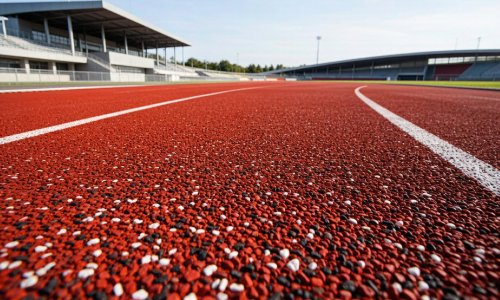
Particle size is expressed as a screened range such as 1-3 mm, 1-3.5 mm, 2-4 mm or 3-6 mm. A smaller range gives a finer, more uniform texture; a larger range gives a more open, pronounced grain. The range also affects how the material spreads and how it interacts with the binder, so it should be confirmed against the installation method rather than chosen from a picture.
Two existing articles go deeper on this: one on choosing EPDM granule size, and one on particle size, mesh size and particle distribution.
2.2 Color, Color Blend and Batch Consistency
Color is a material property with a production implication. A single-color granule and a blended multi-color granule behave differently on site: blends hide local variation and give the surface a finer visual grain, while solid colors show soiling and uneven wear more clearly. Whichever route the project takes, the reference should be a physical sample from a defined batch rather than a screen preview.
For a closer look at color control, see the articles on how EPDM granules achieve exact color matching and on colored EPDM granules, safety and certification.
2.3 Formulation, UV Stability and Wear Resistance
Two granules can look identical in a sample tray and still behave differently after three summers outdoors. What separates them is the formulation: the pigment system, the polymer content and how the material is screened and cleaned. These are manufacturing decisions, so they are the questions to put to the producer.
The published technical background is covered in UV resistance and wear performance in EPDM granules, and the mechanical side in EPDM granule hardness.
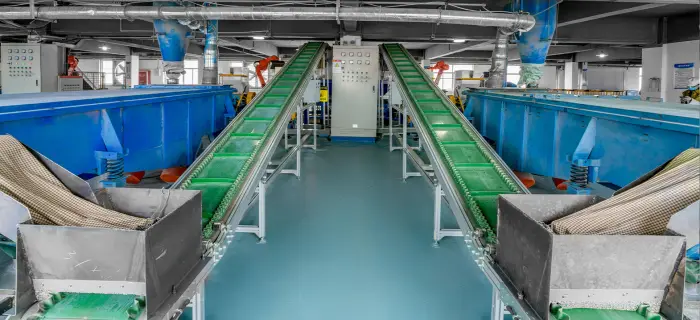
Screening is where a particle size range becomes a real specification. Oversize particles and fines both change how the granule spreads and how much binder the mix absorbs.
When a project needs something other than the standard range, particle size, color, formulation and packaging can all be discussed as a custom requirement.
2.4 EPDM Granule and PU Binder Specification Checklist
Before confirming a supplier, request the following. The list is deliberately material-focused, because buying by granule price alone is the most common procurement mistake in this category.
- EPDM granule color sample taken from a defined production batch
- Particle size range and the screening tolerance behind it
- UV aging or color fastness test reference for the selected formulation
- Heavy metal or safety test report where the surface is used for playgrounds
- Recommended PU binder ratio for the top layer and for the base layer
- Estimated EPDM granule and PU binder consumption per square meter at the target thickness
- Batch color consistency control and reorder reference for repeat orders
- Packaging format and spare material recommendation for site repairs
3. Matching EPDM Granules with the Right PU Binder
The binder is the second half of the material decision. EPDM granules and PU binder are bought together, and a granule that performs well with one binder ratio can behave differently with another. Factors include the particle surface area of the selected range, the layer the mix goes into, the installation method and the site climate.
For that reason it is worth treating binder ratio as part of the granule specification rather than a rule of thumb carried between projects. The ratio that suits a thin top layer over a firm base is not automatically right for a thick, impact-absorbing base build-up.
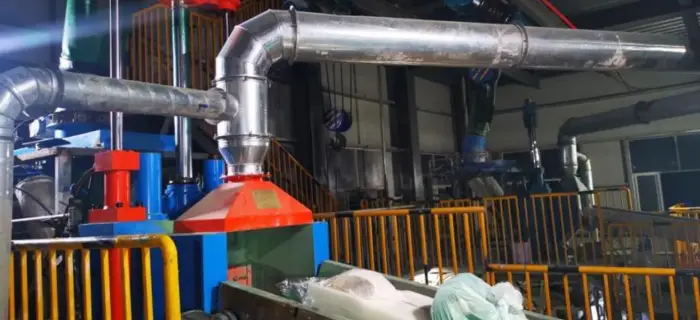
FieldsMaster supplies the granule and the binder as matched materials, so the ratio recommendation is given for the specific granule and the specific layer, not as a single figure for the whole system.
See the PU binder range for the product overview, and the tensile test comparison across binder models for the technical view.
| Part of the system | Material supplied | What it affects most |
|---|---|---|
| Base layer or underlayer | SBR granules plus PU binder | Impact absorption, leveling and total system thickness |
| Bonding and adhesion | PU binder system | Bonding strength between granules and to the base, and therefore service life |
| EPDM granule top layer | Colored EPDM granules plus PU binder | Color fastness, UV resistance, surface texture and visual quality |
3.1 Why the Binder Question Keeps Coming Back
Binder decisions reappear at every stage of a granule project: choosing the grade, agreeing the mixing ratio, planning consumption, and getting the drums to site undamaged. Three existing articles cover the practical side in more detail: why construction sites need aliphatic binder, PU binder logistics and intact delivery, and the guide to mixing EPDM granules with binder.
The supplied granule and binder specification, together with the installation method agreed with the contractor, is what determines the final result. Where a project sets a performance target, that target should be verified against the material documentation applicable to the selected granule and binder.
4. Where EPDM Granules Are Used: Tracks, Courts, Playgrounds and Fitness Areas
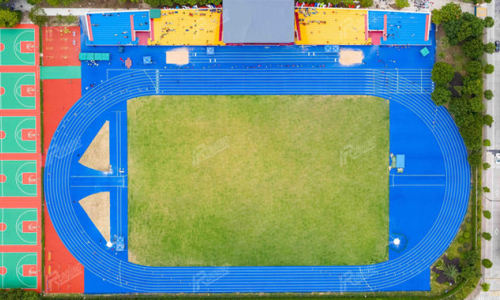
EPDM granules are used wherever an outdoor surface needs color, grip and weather resistance without becoming hard underfoot: running tracks and training areas, multi-sport courts, children's playgrounds, outdoor fitness zones, and public recreation spaces.
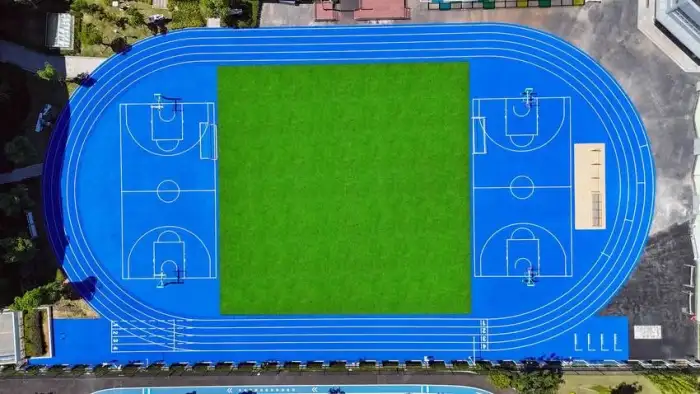
The application decides the granule grade. A running track places more weight on rebound, grip and lane durability, while a playground places more weight on the impact system built underneath the granule layer.
FieldsMaster supplies granule grades organized by application, which is a practical starting point. See the EPDM granule range for sports tracks and the full EPDM granules overview.
4.1 Four Project Types and the Granule Requirement
| Project type | Common EPDM layer thickness | Key performance requirement | Typical buyer concern |
|---|---|---|---|
| Running tracks | 8-13 mm surface layer depending on system design | UV resistance, anti-slip texture, stable rebound | Color retention, lane durability, compliance |
| Multi-sport courts | 8-10 mm surface layer | Wear resistance, ball response, safe grip | Balance between cost and playability |
| Playgrounds | 10-13 mm or thicker depending on fall-height requirement | Impact absorption and child safety | Safety documentation, color design, aging resistance |
| Outdoor fitness areas | 8-13 mm depending on equipment and use intensity | Shock absorption, equipment-zone durability | Compression resistance and low maintenance |
For most outdoor projects, 8-13 mm is a common specification range for the EPDM granule wear layer. The final thickness should be confirmed according to project use, safety requirements, local standards and base condition. Playground projects should follow the fall-protection requirements that apply in the project location.
5. How Granule Systems Are Built: Wet Pour, Tiles and Rolls
The granule is the same material in each case. What changes is how it is delivered to site and how it is installed, and that choice affects design freedom, installation speed and how easily a damaged area can be repaired.
5.1 Granule surfacing installed on site
Colored EPDM granules are mixed with PU binder on site and troweled or sprayed over the prepared base. This is the most flexible route and the one that supports custom colors, logos, lane markings and curved layouts.
5.2 Wet pour EPDM surfacing
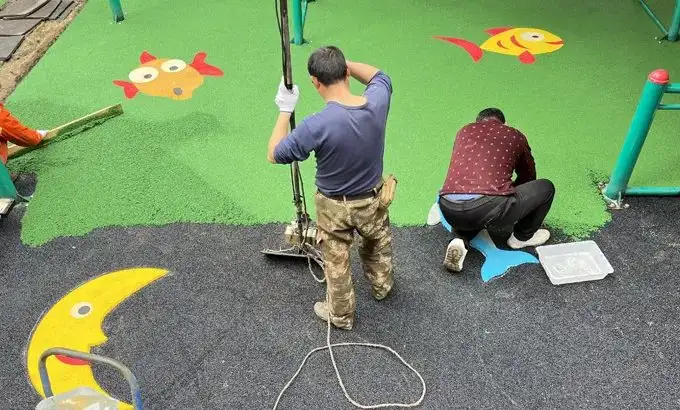
Wet pour combines a shock-absorbing base layer with a colored EPDM granule top layer, and is commonly used for playgrounds, tracks, courts and public recreation areas.
It suits projects that need seamless installation, curved edges, multi-color graphics or safety-focused design. Because it is installed on site, quality control depends heavily on binder ratio, installer skill, weather conditions and base preparation. The full system is described in the guide to wet pour rubber surfacing.
5.3 Tiles and rolls
EPDM tiles are prefabricated rubber units that install faster than wet pour and allow modular replacement, at the cost of visible seams and careful edge bonding outdoors. EPDM rolls are factory-made surfaces supplied in rolls, offering consistent thickness and faster coverage for rectangular areas, but less flexibility for complex graphics, irregular shapes or on-site thickness adjustment.
5.4 Four-solution comparison
| Surface option | Common thickness | Expected lifespan | Cost position | Best-fit scenarios |
|---|---|---|---|---|
| EPDM granule surface | 8-13 mm top layer | 8-10 years with proper installation and maintenance | Medium | Running tracks, courts, playgrounds, outdoor fitness areas |
| Wet pour EPDM | 10-13 mm or customized system thickness | 8-10 years with correct base layer and PU binder ratio | Medium to high | Playgrounds, curved spaces, custom color projects, safety areas |
| EPDM rolls | Factory-controlled thickness | 6-8 years depending on use and exposure | Medium | Rectangular courts, training areas, projects requiring faster installation |
| PU track surface | System-dependent | 8-10 years depending on system grade | High | Professional running tracks and performance-oriented venues |
For a buyer comparing options, the decision is whether the project needs a seamless, customized and repairable granule surface or a faster modular installation. Either way the granule and binder quantities are what the material quotation is built from.
6. Cost Per Square Meter: Granule, Binder and Base Layer Share
For most outdoor projects, the installed cost of an EPDM rubber surface is commonly planned around 18-35 USD per square meter. The range assumes a common outdoor system with an 8-13 mm EPDM granule top layer and standard site conditions. It does not include major civil works, drainage rebuilding, tax, import duty, unusual base repair or long-distance freight.
On the material side, FieldsMaster quotes EPDM granules, PU binder, SBR base layer material and estimated installation loss separately, because local labor and base preparation can change the installed price significantly.
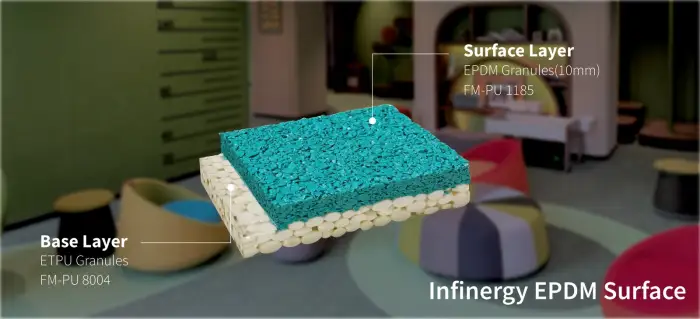
Separating the quotation into three cost layers shows which part of the budget is driving the total and makes two supplier quotations comparable rather than merely different.
The granule is only one of the three layers, which is the practical reason a low granule price does not automatically produce a low project cost.
| Cost layer | What it includes | Typical cost influence |
|---|---|---|
| Base layer or underlayer | SBR granules, PU binder, leveling and impact absorption | High impact on shock absorption and total thickness |
| PU binder system | Adhesive for base layer and top layer | Directly affects bonding strength and service life |
| EPDM granule top layer | Colored EPDM granules and final surface texture | Strongest influence on color fastness, UV resistance and visual quality |
6.1 Why cost cannot be judged by granule price alone
If a low-cost granule fades quickly, hardens under sunlight or separates from the binder, the buyer faces early repair, replacement and reputation risk. The more useful procurement question is what the total installed cost per square meter comes to over the expected service life, taking material consumption, binder ratio, surface thickness, installation loss, maintenance and replacement cycle into account.
6.2 EPDM granule surfaces compared with asphalt and PU tracks
Asphalt is often selected because it looks economical at the start, but it is hard, less impact-absorbing and limited in color. PU track systems deliver strong athletic performance for professional venues, at a higher system cost and with stricter installation control. An EPDM granule surface sits between the two, combining color flexibility, outdoor durability, anti-slip texture and safety performance.
| Surface type | Main advantage | Main limitation | Best buyer fit |
|---|---|---|---|
| Asphalt | Lower initial cost and simple construction | Hard surface, limited safety and color options | Basic non-impact areas |
| EPDM granule surface | Colorful, UV-resistant, safer and more flexible | Requires correct binder ratio and base preparation | Schools, parks, courts, playgrounds, public sports areas |
| PU track surface | Professional sports performance | Higher system cost and stricter installation control | Stadiums and professional athletics tracks |
Running track projects in particular place demands on the granule layer, which is covered in more detail in the running track surfacing solutions guide.
7. Why EPDM Granules Age Better Outdoors Than PVC and SBR
Outdoor surfaces face sunlight, rain, temperature swings, abrasion and cleaning chemicals, which makes the aging behavior of the granule the deciding property rather than its initial appearance.
EPDM granules are usually preferred over PVC in exposed outdoor use because they offer stronger weathering resistance and better long-term color stability when the formulation is properly controlled. PVC can become harder or less stable under long-term UV and heat exposure, depending on formulation and site conditions.
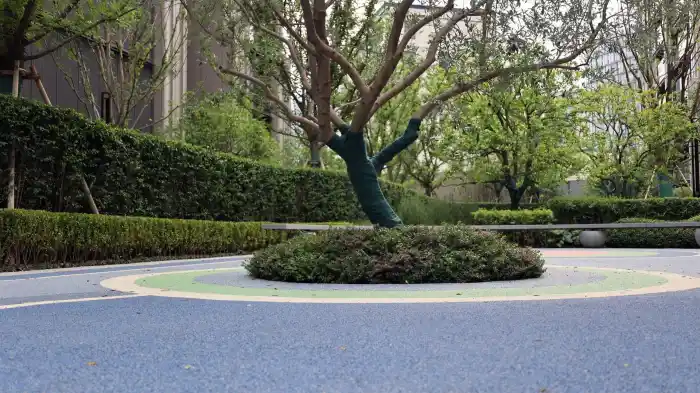
Compared with SBR, EPDM offers stronger color design and outdoor aging performance. SBR is cost-effective and widely used in the base layer for shock absorption, but it is not the best choice for the exposed colored top layer.
For a visible outdoor surface, EPDM granules are the material that carries the color. The comparison is covered in EPDM versus SBR and in why EPDM granules dominate sports surfaces.
Color retention should be confirmed against the requirements of the specific project rather than assumed from a sample. Ask the supplier for the UV aging or color fastness test reference that applies to the selected granule formulation, because actual performance depends on the pigment system, granule formulation, binder ratio, installation quality and local climate. Where a project sets a color stability target, that target should be verified against the standard applicable in the project location.
8. How FieldsMaster Supports EPDM Granule and PU Binder Buyers
FieldsMaster manufactures EPDM granules and PU binder. The company does not sell surfacing as a lump-sum service, so the working relationship with a buyer is material-focused: granule grade and particle size, color and batch control, binder grade and ratio, packaging, and a material quantity for the project.
8.1 From granule formulation to batch consistency
Colored EPDM granules and binder are produced in batches, and the useful output for a project is a specification that can be repeated. That covers the standard color range, custom color development against a physical reference, formulation discussions around UV and wear requirements, and packaging that suits the buyer's logistics. See the customization center, the regular color card, the manufacturing overview, and the OEM and ODM program.

Technical review: FieldsMaster Sports Surfacing Team, working on EPDM granule formulations, PU binder systems and outdoor rubber sports surface material calculation for contractors, distributors and project owners.
Buyers can request granule and binder samples, formulation guidance, batch consistency support and test-document references according to the project requirements, including safety-related documentation for playground and public-space projects.
8.2 Samples, documentation and project calculation
For contractors, distributors and project owners, the practical deliverables are a physical granule sample against a defined batch, the matching binder recommendation, and a material list for the project area. Samples are requested through the free sample request page, and a first-pass material estimate is available through the EPDM material calculator.
For distributors and brand owners, the same materials can be discussed as a product program covering particle size, color, formulation and packaging under the buyer's own brand.
9. Get a Granule Quote and Material Calculation in 48 Hours
If you are planning a granule-based sports surface, the fastest way to avoid overbuying or underestimating material is to calculate from project parameters rather than from a generic price per square meter.
Before requesting a quotation, prepare the following information:
- Total project area in square meters.
- Application type: running track, court, playground, fitness area or mixed-use space.
- Target thickness for base layer and EPDM granule top layer.
- Color plan and the percentage of each color in the blend.
- Site location and expected installation season.
- Whether you need only EPDM granules and PU binder, or a full package quotation.
FieldsMaster converts these parameters into granule consumption, PU binder requirement, estimated installation loss and a packaged quotation. Submit your site parameters through the EPDM surfacing solutions for sports and outdoor projects page or the project quotation page and receive a material calculation and package quotation within 48 hours. The EPDM surfacing guide for project owners covers the specification step in more detail.
If you already know your project area and target thickness, send us just three numbers: total square meters, base layer thickness and EPDM granule top layer thickness. FieldsMaster will turn them into a practical material list — EPDM granules, PU binder, estimated material loss and packaging quantity — so you can see whether your current supplier quotation accounts for all three before you place the order.
9.1 The three items most often missing from a granule quotation
Granule price is the easiest line to compare and the least likely to be wrong. The lines that cause shortfalls are the ones that get estimated instead of calculated.
- PU binder. Often quoted as a rounded allowance rather than a quantity derived from the selected granule, the layer it goes into and the agreed binder ratio. When the actual mix demands more, the difference has to be ordered at short notice.
- Material loss. Frequently left out of the material list or covered by a flat guess. Loss changes with the particle size range, substrate condition, layer thickness, weather during installation and installer technique, so it should appear as a stated figure rather than an assumption.
- Packaging quantity. Quoted per bag, drum or pallet without being reconciled to actual consumption, which makes it hard to see whether the order covers the project or leaves a shortfall.
Each of these gaps ends the same way: the shortfall surfaces mid-installation, when reordering is slowest and most expensive, and the only remaining options are to pause the crew or accept a substituted material. Checking the three figures against the project parameters before the order is placed is exactly what a material calculation is for — and it is the fastest way to see whether a supplier quotation is complete.
10. FAQ
What are EPDM granules made of?
EPDM granules are colored rubber particles produced from EPDM (ethylene propylene diene monomer) rubber. In a sports surface they are mixed with PU binder and installed over a stable base layer, where they form the exposed wear layer that provides color, UV resistance, anti-slip texture and durability.
What is the difference between EPDM granules and SBR granules?
They serve different layers. SBR granules are cost-effective and widely used in the base layer for impact absorption, while EPDM granules are used for the exposed colored top layer because they offer stronger UV resistance, color stability and weather aging performance. For a visible outdoor surface, EPDM is usually the better granule.
How do I choose the right EPDM granule size?
Granule size is a screened range such as 1-3 mm or 2-4 mm rather than an exact dimension. The choice depends on the required surface texture, the installation method, the layer thickness and the project specification, and it should be evaluated together with the binder rather than in isolation.
How much EPDM granule and PU binder does a project need?
Consumption depends on area, layer thickness, the selected particle size range, the binder ratio, installation loss and the packaging format. Because a 1,000 square meter project with an 8 mm granule layer needs a very different material package from the same area at a thicker system build-up, FieldsMaster calculates per project rather than quoting a single universal figure.
How much does an EPDM surface cost per square meter?
For most outdoor projects in 2026, an EPDM surface is commonly planned around 18-35 USD per square meter installed. The final cost depends on surface thickness, project size, color selection, PU binder ratio, local labor cost, base condition and logistics, while the material-only quotation is built from granule and binder consumption.
How long do EPDM granules keep their color outdoors?
Color retention depends on the pigment system, the granule formulation, the binder ratio, installation quality and local climate rather than on a single figure. Ask the supplier for the UV aging or color fastness test reference for the selected granule formulation, and verify any project-specific color stability target against the standard applicable in the project location.
Before you place the order, check three figures. Most granule quotations are complete on the granule line and incomplete everywhere else, and the gaps are always the same three:
- PU binder — a quantity calculated from the selected granule, the layer it goes into and the agreed binder ratio, not a rounded allowance.
- Material loss — a stated figure for this project, because loss moves with the particle size range, substrate condition, layer thickness, installation weather and installer technique.
- Packaging quantity — reconciled to actual consumption, so the order is neither short of site nor carrying surplus drums and bags.
Any one of them missing surfaces mid-installation, when reordering is slowest and most expensive and the crew is already on site. Send FieldsMaster three numbers — total square meters, base layer thickness and EPDM granule top layer thickness — through the project quotation page, and the material list comes back accounting for all three within 48 hours.