

How to Choose EPDM Granule Size: 1-3mm vs 2-4mm vs 3-6mm
Choosing the right EPDM granule size is an important step in planning a rubber surfacing project. Whether you are developing a children's playground, running track, poolside area, recreational walkway, or landscaping surface, particle size can influence the finished texture, visual appearance, and installation process.
But which EPDM granule size should you choose: 1-3mm, 2-4mm, or 3-6mm?
The answer depends on your application, surfacing system, layer thickness, PU binder, installation method, and project requirements. At FieldsMaster, 1-3.5mm EPDM granules are developed as a practical standard size for installation-focused surfacing projects. When a project requires a different particle range, color, formulation, or packaging specification, FieldsMaster can also discuss customized solutions based on the application and customer requirements.
This guide explains how to compare EPDM granule sizes, why FieldsMaster uses a 1-3.5mm standard, and how customization can support different surfacing and product-development projects.
Key Takeaways
- Granule size is a range, not an exact dimension. 1-3mm, 1-3.5mm, 2-4mm and 3-6mm describe screened particle ranges rather than a uniform granule size.
- Evaluate size inside the whole system. The same particle range can behave differently depending on layer thickness, Base Layer construction, PU binder, installation method, substrate, drainage, climate and project specification.
- FieldsMaster standard. 1-3.5mm EPDM granules are offered as a practical standard particle range for installation-focused surfacing projects. It is a starting point for evaluation, not a universal rule.
- Customization is available. Particle size, color, formulation, packaging and OEM or ODM development can all be discussed according to the application and manufacturing feasibility.
- Avoid assumed cause and effect. A larger granule does not automatically improve drainage, and no single binder ratio applies to every granule size. Confirm both against the specific system.
1. What Is EPDM Granule Size?
EPDM granule size describes the screened particle size range used in an EPDM rubber surfacing system. Common ranges include 1-3mm EPDM granules, 1-3.5mm EPDM granules, 2-4mm EPDM granules, and 3-6mm EPDM granules.
These measurements describe particle ranges rather than guaranteeing that every granule has exactly the same dimension.
The selected size range can influence the finished surface texture, the visual appearance, material spreading, installation behavior, and the interaction with the PU binder.
However, granule size should always be evaluated within the complete surfacing system. The same particle range may behave differently depending on layer thickness, Base Layer construction, PU binder, installation method, substrate condition, drainage design, climate, and project specification.
Why Is Granule Size Important for Buyers?
For procurement teams, contractors, and installers, granule size is not simply a product specification. It is part of a larger decision involving the finished surface, construction process, and intended application.
The right question is not only "which granule size should I buy?" A more useful question is: which granule size fits my project, installation method, and surfacing system?
2. EPDM Granule Size Comparison
The following comparison provides a starting point for discussing particle size and surface appearance. It is not a universal specification for every application.
| Granule Size | Typical Surface Character | Project Considerations |
|---|---|---|
| 1-3mm | Fine, relatively uniform texture | Review appearance, spreading method, layer design, and compatibility |
| 1-3.5mm | FieldsMaster standard particle range; intended for evaluation in installation-focused projects | Confirm system design, installation method, and application requirements |
| 2-4mm | Balanced texture with clear granule definition | Review workability, visual expectations, and complete system design |
| 3-6mm | More open and pronounced texture | Review finish expectations, comfort, layer thickness, and installation technique |
FieldsMaster's Standard Particle Range
FieldsMaster offers a controlled 1.0-3.5mm EPDM granule range as a standard product specification. The range is positioned for projects where a practical particle-size option is required.
The standard range does not eliminate the need for project-specific selection. Instead, it provides a starting point for discussing the intended application and installation requirements. You can review the full range on the FieldsMaster EPDM granules page, and read more about screening in our article on optimizing particle size, mesh size and particle distribution.
3. Why FieldsMaster Uses 1-3.5mm EPDM Granules
FieldsMaster's 1-3.5mm EPDM granule range is one of the company's product specifications. The range is designed to provide a practical option for customers who are evaluating EPDM granules for surfacing applications.
Compared with selecting an unspecified particle range, a clearly defined product size gives project teams a more concrete basis for material discussions, sample review, and procurement.
What Makes the 1-3.5mm Range Relevant?
FieldsMaster's published technical content positions the 1-3.5mm size as a refined standard developed around installation and surface-finish considerations, in relation to surface leveling, visual uniformity, and binder-related handling considerations. These considerations should be evaluated according to the specific system and installation conditions.
Surface Finish Considerations
Particle size can influence the visual grain and texture of a finished surface. FieldsMaster's 1-3.5mm range can be evaluated when the project requires a defined particle range and a controlled surface appearance. The final result also depends on color blend, layer thickness, installation method, surface preparation, and finishing technique.
Installation Considerations
Particle size can affect how EPDM granules are handled and spread during installation. FieldsMaster's standard range provides a defined material option for project discussions, while the installation team should still confirm the appropriate system and working method.
A Standard Option, Not a Universal Rule
FieldsMaster recommends evaluating its 1-3.5mm standard in the context of the actual application. It should not automatically replace other particle ranges where the project requires a different specification. FieldsMaster's approach is to start with a practical standard, then adapt the material selection when the customer's requirements call for customization.
4. Can EPDM Granule Size Be Customized?
Yes. FieldsMaster supports customized particle-size discussions.
Different projects may require different EPDM granule sizes. For example, a contractor may have a specific installation preference, a manufacturer may need a particular particle range for a rubber product, or a distributor may want to develop a product specification for a regional market. FieldsMaster's customization service supports discussions around particle size, color, formulation, packaging, and other product requirements.
Why Customize EPDM Granule Size?
Particle-size customization may be relevant when a project has a specific material specification, a manufacturer requires a defined particle range, a customer needs a particular surface texture, a distributor is developing a product program, a brand owner requires a differentiated product offering, or the standard size does not match the intended application.
The final feasibility of customization depends on the product, application, and manufacturing requirements.
Examples of Particle-Size Discussions
Depending on the project, customers may discuss standard 1-3.5mm EPDM granules, finer particle ranges, larger particle ranges, application-specific particle-size requirements, or custom particle-size specifications. The available range and final specification should be confirmed with the FieldsMaster technical team.
Start with the standard. Adapt to the project. Confirm the specification. To begin that conversation, discuss your custom EPDM granule requirements with our team.
5. FieldsMaster EPDM Granule Customization Services
Particle size is only one part of product customization. For customers developing a specific product line, regional offering, or project material specification, FieldsMaster also provides several customization directions.
5.1 Customized EPDM Granule Colors
Color can influence the visual identity of a surfacing project and the product range offered by a distributor or manufacturer. FieldsMaster offers 114+ color options, covering standard color selection and custom color development.
Customers can discuss standard color selection, custom color matching, RAL or Pantone references, customer-provided color samples, color formula development, and repeat-order color reference. The FieldsMaster customization center describes color development and reference matching as part of its customization service, and standard color references are published in the FieldsMaster Regular Color Card.
This direction is typically relevant to sports surfacing contractors, playground installers, EPDM product manufacturers, distributors, brand owners, and OEM or ODM customers. See color matching for details.
5.2 Customized EPDM Color Blends
A mixed-color EPDM surface can be developed around the desired visual appearance and application. The FieldsMaster Color Mix Tool allows users to explore color combinations and mixing ratios before requesting a physical sample. The company's published service information also describes factory pre-mixing for specified blends.
The process is straightforward: select the colors, define the mixing ratio, review the digital color design, request a physical sample, confirm the approved blend, and use the confirmed formula as a production reference where applicable.
A defined color blend can help contractors and customers discuss the intended appearance before production. It also creates a clearer reference for repeat orders and project coordination.
5.3 Customized EPDM Granule Formulation
Some projects require additional product discussions beyond size and color. Depending on the application, FieldsMaster's customization service can discuss formulation-related requirements, including polymer content and selected specialized properties. Possible discussion areas include polymer content, UV-related formulation requirements, temperature-related requirements, wear-related requirements, and other application-specific requirements.
Please note that the suitability and performance of any customized formulation must be confirmed through applicable technical review and supporting documentation.
This direction is typically relevant to product manufacturers, distributors, project-specific material development, and OEM or ODM programs.
5.4 Customized EPDM Packaging
Packaging can be part of a product's market presentation and logistics planning. FieldsMaster's customization center describes options including PE valve bags, plastic bags, and kraft paper bags, with customization of selected packaging content.
Customers can discuss packaging format, packaging content, custom printing, brand presentation, and logistics requirements. The final packaging specification should be confirmed based on the product and shipping requirements.
5.5 OEM and ODM EPDM Granule Development
For manufacturers, distributors, and brand owners, FieldsMaster can discuss product-development requirements beyond standard material supply. Potential development areas include particle size, color, formulation, packaging, Private Label, and a PU Binder program.
FieldsMaster's OEM and ODM service page describes these product-development directions and emphasizes connecting the product with the customer's application and market requirements. This direction suits rubber mat manufacturers, rubber flooring manufacturers, EPDM product brands, regional distributors, and private-label product programs. For packaging and private-label discussions, see our OEM and ODM services.
6. How to Choose EPDM Granule Size by Application
The application should be one of the first questions in an EPDM granule selection discussion. Different applications may require different technical and practical considerations.
6.1 Running Tracks and Sports Surfacing
Sports surfacing projects require material selection that aligns with the specified system design and intended finish. When discussing EPDM granule size, consider the Top Layer or Base Layer role, the required surface texture, the installation method, layer thickness, the project specification, and sample requirements.
FieldsMaster's 1-3.5mm standard can be evaluated as a starting point where the project requirements are compatible. If a different particle range is required, discuss customization with the technical team. For the complete system picture, see running track surfacing.

6.2 Children's Playgrounds
Playground surfacing requires attention to the intended use, fall-protection requirements, system thickness, and installation quality. Granule size contributes to the finished texture and appearance, but it does not independently determine safety.
What should be reviewed? Fall-protection requirements, the Base Layer and Top Layer, layer thickness, drainage, the applicable standards for the project location, and the installation method. FieldsMaster's 1-3.5mm standard may be evaluated for suitable project systems, subject to technical review. Safety performance is a property of the complete installed system and must be verified against the standards applicable to the specific project. See children playground surfacing for more detail.
6.3 Poolside and Splash Pad Surroundings
Poolside projects require consideration of water management, surface usability, and the complete system design. Review the substrate, drainage, surface slope, chemical exposure, barefoot comfort, and cleaning expectations. FieldsMaster can discuss granule size, color, PU binder, and other material considerations in relation to the project. See poolside surfacing.
6.4 Walkways and Landscaping
Landscape projects often place emphasis on appearance, comfort, and integration with the surrounding environment. FieldsMaster's standard particle range can be evaluated alongside alternative particle-size options when the project requires a different visual or installation specification.
Review the desired texture, color blend, viewing distance, lighting, maintenance expectations, and installation method. See residential landscape surfacing.
6.5 Artificial Turf Infill
Artificial turf infill is system-specific. Do not assume that a particle size used in poured EPDM surfacing is automatically suitable for turf infill. Confirm the turf manufacturer requirements, infill depth, intended use, maintenance method, and the applicable standards before selecting a granule size. See artificial turf infill.
7. How Particle Size Affects Surface Texture and Installation
Surface Texture
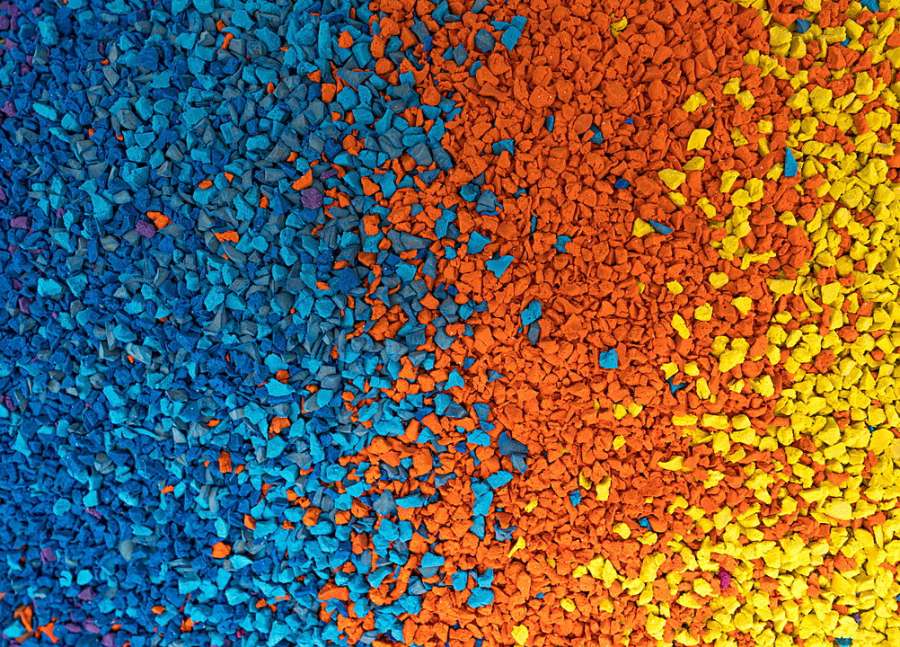
Finer particle ranges generally create a finer visual grain, while larger ranges may create a more pronounced texture. However, the final appearance also depends on color, blend ratio, lighting, installation technique, and viewing distance.
PU Binder Use
Particle geometry and surface area can influence mixture handling and binder demand within a specific system. Binder requirements should be confirmed according to the selected material, system structure, installation method, and technical guidance. Do not apply a universal binder ratio to every EPDM granule size.
Drainage
A larger particle size does not automatically guarantee better drainage. Drainage depends on the complete system, including the substrate, slope, Base Layer, and drainage design.
Installation Behavior
Different particle ranges may influence spreading and finishing behavior. Review crew experience, tools, weather conditions, layer thickness, installation method, and supplier guidance.
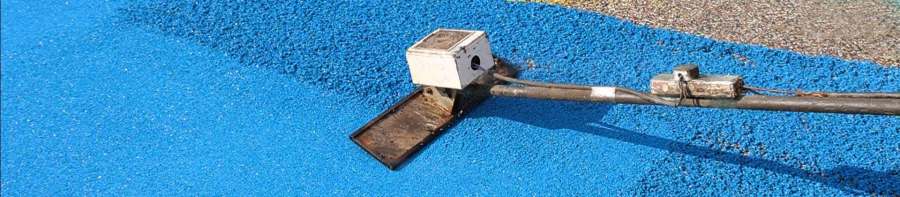
For practical installation steps, see our guide on mixing EPDM granules with binder.
8. Five Common EPDM Granule Selection Mistakes
- Mistake 1: Choosing only from a product photo. Request a physical sample when appearance matters.
- Mistake 2: Assuming larger granules always improve drainage. Review the complete system instead of particle size alone.
- Mistake 3: Using one size for every application. Start with the application and system requirements.
- Mistake 4: Treating binder ratio as universal. Confirm the appropriate mix design for the actual material and system.
- Mistake 5: Ignoring customization options. If the standard size does not meet the project requirement, discuss alternative particle sizes, colors, formulations, or packaging.
FieldsMaster offers a standard 1-3.5mm option while also supporting customization discussions for specific customer requirements.
9. A Practical FieldsMaster Selection Process
- Define the project: application, country, area, color, timeline, and technical requirements.
- Review the system: layer structure, thickness, substrate, drainage, and installation method.
- Evaluate the standard size: review whether FieldsMaster's 1-3.5mm standard is appropriate for the project.
- Discuss customization: if the project requires another particle range, color, formulation, or packaging specification, discuss the customization options.
- Review samples: confirm the proposed material and visual appearance where required.
- Confirm production requirements: review the approved specification, packaging, production timing, and delivery requirements.
The goal is to connect the material selection with the actual project, not to choose a particle size in isolation.
10. Frequently Asked Questions
Is 1-3.5mm a good EPDM granule size for installation?
FieldsMaster offers 1-3.5mm as a standard particle-size option for evaluation in suitable surfacing projects. Its suitability depends on the complete system, installation method, and project requirements.
Why does FieldsMaster use 1-3.5mm EPDM granules?
FieldsMaster's published product and technical content positions 1-3.5mm as a standard particle range developed around practical surfacing and installation considerations. The final suitability should be confirmed according to the specific project.
Can FieldsMaster customize EPDM granule size?
Yes. FieldsMaster can discuss customized particle-size requirements according to the application, product specification, and manufacturing feasibility.
How many EPDM granule colors does FieldsMaster offer?
FieldsMaster offers 114+ color options, covering standard color selection and custom color development.
Can FieldsMaster create mixed-color EPDM granules?
Yes. FieldsMaster provides color blending tools and discusses factory pre-mixed color solutions for specified blends.
Can FieldsMaster provide customized packaging?
FieldsMaster offers packaging customization discussions for selected packaging formats and requirements.
Can FieldsMaster develop OEM or ODM EPDM products?
FieldsMaster supports OEM and ODM discussions involving particle size, color, formulation, packaging, and related product-development requirements.
Is a larger EPDM granule size better for drainage?
Not automatically. Drainage depends on the complete system, including the substrate, slope, Base Layer, and drainage design.
What information should I provide for a granule-size recommendation?
Provide the application, project area, system structure, thickness, color, country, installation timeline, and technical requirements.
11. Get a Granule Size Recommendation from FieldsMaster
FieldsMaster's 1-3.5mm EPDM granules provide a practical standard option for project discussions. If your project requires a different particle size, color, formulation, or packaging specification, FieldsMaster can discuss customized solutions based on your requirements.
To help us respond usefully, please share the following project details:
- Application: playground, sports surface, poolside, landscape, or other
- Particle size: standard 1-3.5mm or your requested size
- Project area: total surface area
- System structure: Base Layer, Top Layer, and thickness
- Color: target color or blend
- Country: project location
- Installation timeline: expected schedule
- Customization needs: color, size, formulation, packaging, or OEM or ODM
You can request a granule size recommendation, ask about color matching, request a sample, or discuss OEM and ODM development.
Verified FieldsMaster reference data
The following published specifications are available for review when evaluating EPDM granules:
- Standard particle range: 1.0-3.5mm EPDM granules, positioned as a practical standard for installation-focused surfacing projects.
- Color range: 114+ color options, covering standard color selection and custom color development. See the FieldsMaster Regular Color Card.
- Production capacity: a combined annual production capacity of 600,000 tons across the group's EPDM granule manufacturing operations.
- Mechanical test reference: tensile strength and elongation at break are measured to DIN 53504:2017 for the relevant product grades.
- Compliance documentation: certification reports from professional testing institutions including REACH, SGS and EN 71 are described in the customization center.
- Pre-shipment inspection: FieldsMaster's published process describes multi-step inspection before shipment. See how FieldsMaster EPDM granules pass inspection before shipment.
Color counts and capacity figures reflect FieldsMaster's published figures at the time of writing. Product specifications, customization options and compliance documentation vary by grade and by project. Confirm the applicable data sheet, test report and certificate for the specific product before specifying it. This guide is a selection aid and does not replace project-specific technical review.
Prepared by Master Gong, FieldsMaster laboratory, together with the FieldsMaster Technical Team. Published 18 September 2026.