

EPDM Granules Playground Surfaces: Color, HIC & Samples
An EPDM granules playground surface is procured as a material package rather than as a finished product: colored EPDM granules for the wear layer, PU binder, the Base Layer material, the packaging the material ships in, and the color samples and material documents the project file needs. Children's play areas often use several EPDM colors to separate activity zones, support wayfinding, build themes and coordinate with equipment, so the buying process has to cover two points: selecting the colors the design requires, and confirming that those blends match the real EPDM granules received for the order.
The most common purchasing checkpoints are practical rather than theoretical:
- The playground needs several colors and the buyer has selected a mix on screen. How is the real result confirmed? Use the FieldsMaster Color Card and Color Mix Tool to select the preferred mix, then request a physical sample mixed to that selected direction so the actual granules can be inspected before the order is confirmed.
- How can a granules-only buyer lock color, particle-size range, quantity and delivery requirements? Send the intended use, color reference, particle-size request, required quantity and destination, and organize the sample and order discussion around those inputs.
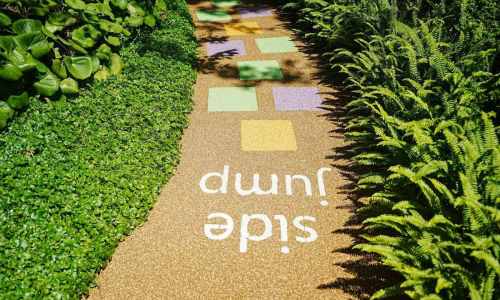
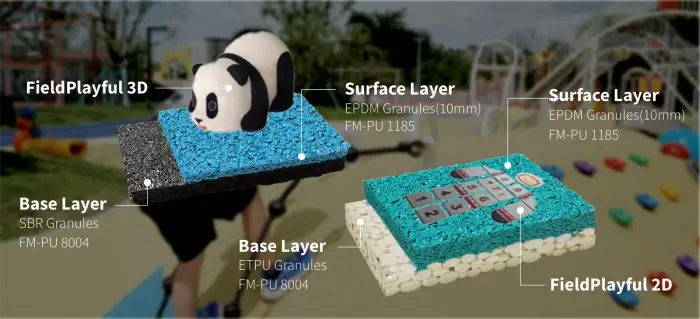
- If a theme includes paths, numbers or play characters, how does it become a usable material list? Match the color plan with FieldPlayful 2D / 3D EPDM graphics, then separate main areas, graphic areas and color quantities before requesting a quotation.
- The equipment schedule gives fall-height information. How does the buyer move from that input to an HIC-related surface discussion? Identify each equipment zone, its relevant fall-height information, the required HIC / impact-attenuation criterion in the project file, the installation environment and the proposed surface structure.
- If the order includes a full surface system, how are EPDM granules, PU binder and Base Layer quantities coordinated? Submit the layout and layer schedule for a preliminary quantity review, and keep the final structure tied to the tested system and project requirements.
FieldsMaster supports these decisions with EPDM granules, PU binder, Base Layer options, 114+ standard colors, color-mix preview, samples, 2D / 3D graphics and preliminary quantity planning. The children playground surfacing solutions page identifies 30 years of manufacturing experience, four automated factories and 600,000 tons of annual production capacity — relevant when a buyer needs color, quantity and batch discussions to stay connected from the first sample through delivery.
Quick answer: In the FieldsMaster playground reference structures, a wet-pour surface uses an impact-attenuation Base Layer with a 10 mm EPDM Top Layer. For an EPDM-granules-only order, begin by confirming color, particle-size range, sample, quantity and delivery. For a project that also needs layer coordination, start from the equipment schedule and fall-height information, confirm the project's HIC / impact-attenuation requirement, then review the proposed Base Layer, 10 mm EPDM Top Layer, PU binder and preliminary material quantities. The complete installed-system decision remains subject to the specified system and project requirements.
1. EPDM Granules Playground: Color, Themes and Sample Approval
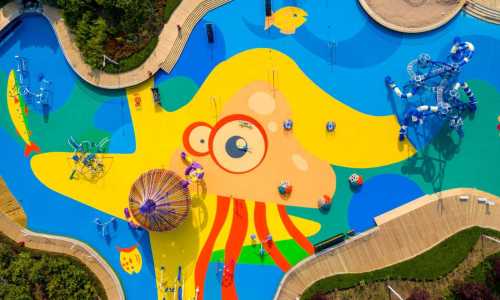
Playground colors can help project teams distinguish age zones, coordinate the surface with equipment and present a themed playground proposal to internal stakeholders.
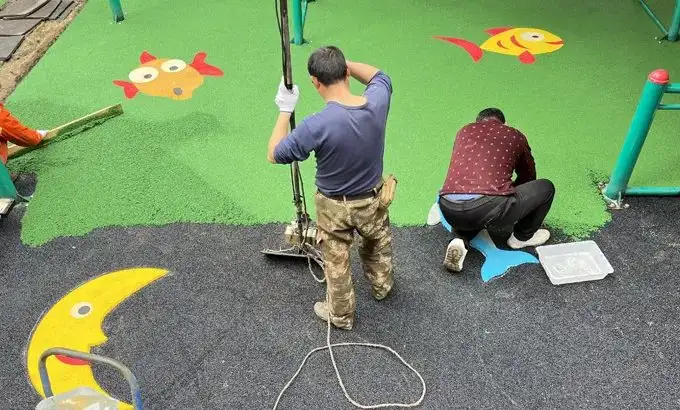
Start with the FieldsMaster Color Card, use the Color Mix Tool to preview the color direction, then send the selected mix together with the playground layout for sample and quantity review. The playground page identifies 114+ standard EPDM colors and 5,000-hour UV testing-backed color performance, giving a buyer a specific reason to move from a screen selection to a physical sample and a documented color reference. If the project needs animal shapes, learning paths, islands, stars, numbers or themed play characters, add FieldPlayful 2D / 3D EPDM graphics to the same planning step. This turns color selection into a quotation-ready workflow instead of a loose design preference.
1.1 Plan Colors Around Play Zones
A clear surface plan can use one color family for a defined zone, a contrasting color for paths or boundaries, and selected graphics near lower-speed play areas. Avoid treating every open area as a separate color opportunity. A smaller number of well-defined colors is often easier to specify, approve, install and replenish later.
| Playground area | Color-planning question | Material-planning implication |
|---|---|---|
| Toddler play zone | Does the zone need a calmer, clearly bounded visual identity? | Confirm color, surface extent and its relationship to nearby equipment |
| Active climbing or sliding zone | Does the design need visible boundaries around higher-use equipment? | Coordinate color layout with the required impact-attenuation structure |
| Circulation route | Should movement paths be distinct from fall zones? | Separate graphics and path areas from the main material take-off |
| Themed play area | Are 2D or 3D graphics part of the approved design? | Confirm graphic scope alongside the selected Base Layer and EPDM Top Layer |
| Future extension or repair area | Will the project need matching material later? | Record the approved color reference, particle-size range and batch-planning requirement |
FieldsMaster can coordinate standard colors, custom color-matching inputs and selected 2D or 3D EPDM graphic options around an approved playground plan. Graphics are a visual enhancement; they work together with, rather than replace, the impact-attenuation structure selected for the project.
1.2 A Closed-Loop Color Process: Preview, Sample, Confirm
For playground buyers, the stronger workflow is not "choose from a static color list and hope the result looks right." FieldsMaster supports a closed-loop color-planning process: first use the color mixing system to preview the target EPDM color combination, then select the preferred mix, request a physical sample, confirm the sample against the project environment, and finally use the confirmed color reference for material quotation and batch planning. This makes the color decision more practical than relying only on a computer screen. The same matching steps are covered in choosing EPDM rubber granules colors for school playgrounds. To test a playground color idea first, open the Color Mix Tool, then use the selected direction for sample confirmation.
2. EPDM Rubber Granules Playground Surface Thickness and Fall Height
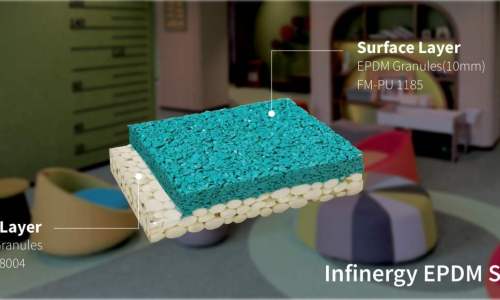
Thickness is a system question, not a color-layer question. In the FieldsMaster playground references, the visible EPDM Top Layer is shown at 10 mm over a selected impact-attenuation Base Layer. The Base Layer can be SBR or ETPU, depending on the selected structure and installation environment, and its thickness is adjusted around the required fall height and HIC performance.
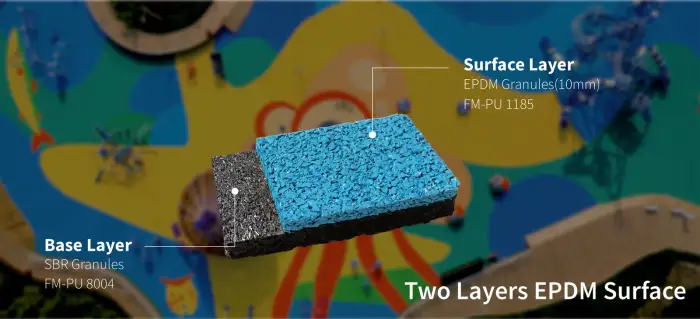
The practical sequence is:
- List the equipment and the relevant fall-height information.
- Identify the play zones and the surface area associated with each equipment group.
- Confirm the required impact-attenuation and testing approach for the project.
- Select the Base Layer material and thickness within the specified system.
- Confirm the 10 mm EPDM Top Layer, granule grade, color, PU binder and installation details.
- Convert the confirmed layer schedule into a material quantity list.
FieldsMaster can prepare the material side of this decision: selected EPDM granules, PU binder, Base Layer inputs, color reference, preliminary quantities and the relevant material-document request. The playground page identifies HIC / EN 1177 requirements together with EN 71-3, REACH and PAHs material references, plus UV ISO 4892-3 and weathering ISO 4892-2 material-reference categories. The completed safety structure is still determined by the project specification, tested system, site base, installation quality and applicable requirements. A generic thickness table is not evidence that a particular finished playground will meet a stated fall-height requirement.
3. HIC Planning: From Equipment Fall Height to a Material Enquiry
HIC is relevant when a project needs to evaluate impact attenuation for the specified playground surface. For buyers, the practical difficulty is rarely the abbreviation itself; it is assembling the right inputs before choosing a Base Layer thickness or requesting a report.

Use this order of work:
- Collect the equipment schedule: identify the equipment, each relevant fall-height input and the related play-zone area.
- Confirm the project criterion: check whether the project file specifies an HIC value, an EN 1177 requirement, another impact-attenuation criterion, or a report format to be submitted.
- Define the intended surface scope: clarify whether the enquiry is EPDM granules only or includes a proposed Base Layer, PU binder and wet-pour structure.
- Review the material inputs: submit the equipment schedule, fall-height information, zone plan, intended application and proposed structure.
- Confirm the system decision at project level against the project drawings and applicable requirements.
This sequence gives a buyer a usable enquiry package without presenting a generic Base Layer thickness as an HIC result.
4. Children Playground EPDM Rubber Granules: Age Group Selection
Age-group labels are useful for design briefing, but they do not replace equipment-specific fall-height or impact-attenuation assessment. A 2 to 5-year-old zone and a 5 to 12-year-old zone may involve different play equipment, movement patterns and design priorities. The surface specification should follow the equipment plan and required performance, not an age label alone. Granule grade and particle-size distribution feed into the same decision; see what EPDM granule sizes and distributions mean for playground surface safety and durability.
For procurement, separate the question into two parts:
- Design and access: how should zones, colors, pathways and graphics make different play activities easier to understand?
- Surface structure: what fall height, HIC requirement, Base Layer and overall tested-system requirement applies to each area?
This keeps the material enquiry usable. It prevents a supplier quotation from being treated as a substitute for a complete safety-surface design or testing decision.
5. Colored Play EPDM Granules: How Many Colors Do You Need?
There is no universal number of colors for an EPDM playground. The right number depends on site scale, equipment layout, the design concept, budget, installation complexity and future maintenance plan. A compact neighborhood playground may work with two or three coordinated colors, while a themed destination project can require a broader palette and separately defined graphic elements.
Rather than asking only "how many colors are available?", ask these procurement questions:
- Which colors form the main EPDM Top Layer areas?
- Which colors define boundaries, paths or graphic details?
- Are any colors blended, custom-matched or subject to a physical sample approval?
- How are separate colors packaged, labeled and sequenced for installation?
- Is a small quantity of the approved material being retained for later repair or extension?
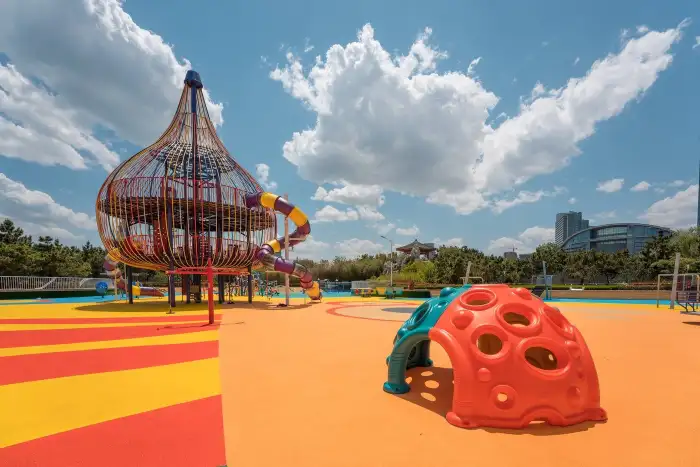
FieldsMaster provides 114+ standard EPDM colors for playground color and graphic planning through its children playground granule series, but the advantage is the full decision loop rather than the color count alone. The buyer can start from the Color Card, test a preferred combination in the Color Mix Tool, select the direction that best fits the playground theme, and then request a sample before final confirmation. The on-screen mix helps the project team express the target color more clearly; the sample then turns that visual choice into a purchasable material reference. For playgrounds with animal shapes, learning zones, paths or themed play characters, the selected color direction can also be coordinated with FieldPlayful 2D / 3D EPDM graphics.
6. EPDM Granule Playground Maintenance and Cleaning
A maintenance plan helps preserve the appearance of a playground surface and makes small issues easier to identify. Maintenance requirements depend on the selected system, environment, use intensity, local debris conditions and the installer's handover guidance.
A practical routine can include:
- Removing loose leaves, litter and foreign objects before they are worked into the surface.
- Checking drainage routes and cleaning areas where water or debris tends to collect.
- Inspecting high-use zones, edges, transitions and areas around equipment for visible wear, lifting or separation.
- Recording localized damage and arranging repair using compatible materials and the approved repair method.
- Keeping a record of the original EPDM granules color, particle-size range, PU binder and material batch information where future matching may be needed.
Loose material, surface separation or other visible changes should be reviewed promptly by the responsible project or maintenance team. The correct repair method depends on the installed system and site condition, and it should not be assumed from a general maintenance checklist.
7. Four Playground Safety-Surface Options: A Procurement Comparison
The most appropriate playground surface depends on fall-height requirements, project budget, climate, existing base, installation conditions, maintenance expectations and design objective. The following comparison is for initial procurement discussion, not a substitute for project-specific safety assessment.
| Surface option | Typical procurement focus | Design flexibility | Key question before comparing price |
|---|---|---|---|
| EPDM granules wet-pour surface | EPDM Top Layer, PU binder, Base Layer, fall-height structure and color plan | High: colors, patterns and graphics can be integrated | Does the quotation define the complete impact-attenuation system? |
| Wet-pour rubber surface with a non-EPDM finish | Base material, finish layer, binder and tested-system scope | Varies by product system | Is the visible finish and chemical-performance scope clear? |
| Rubber tiles | Tile format, thickness, joints, adhesive and edge details | Moderate: pattern follows tile options | How will joints, edges and later replacement be managed? |
| Artificial grass with impact pad | Grass specification, infill if used, pad, seams and drainage | Natural-look direction | Does the selected pad and complete assembly match the project requirement? |
For a broader overview of surfacing alternatives, see playground surfacing safety options. For the material-led direction of an EPDM surface, see the future of playground surfaces with EPDM granules.
8. Example: Material-List Framework for a 500 m² Playground
A 500 m² playground does not produce one universal material quantity. The result changes with the final zone layout, fall-height requirement, Base Layer material and thickness, EPDM Top Layer area, color pattern, graphic scope, edge details and site allowance. The following is a quotation-input framework, not a fixed bill of materials:
| Information to provide | Why it changes the material list |
|---|---|
| Total surfacing area and zone plan | Separates main areas, paths, graphics and non-surfaced zones |
| Equipment schedule and fall-height information | Supports the Base Layer and impact-attenuation review |
| Proposed system | Identifies SBR or ETPU Base Layer, EPDM Top Layer and PU binder scope |
| Layer schedule | Establishes thickness inputs for a preliminary quantity calculation |
| Color plan and graphics | Separates EPDM granules by color and defines visual-detail scope |
| Base condition and drainage information | Helps coordinate primer and installation preparation questions |
| Delivery location and required date | Supports packing, shipping and delivery planning |
| Sample, documentation or testing requirements | Keeps material records aligned with the project file |
Once these inputs are available, the EPDM material quantity calculator can support a first-pass EPDM, Base Layer and PU binder estimate. Buyers who purchase EPDM granules only can confirm color, particle-size range, samples, quantity and delivery requirements. When a project also requires layer coordination, the layout, layer schedule and color direction can be used to discuss color-by-color EPDM granules, PU binder, Base Layer inputs, sample confirmation and delivery needs. Final quantities should include the confirmed design, edges, installation allowances and project-specific site conditions.
9. Purchasing Problems to Solve Before They Delay the Order
Playground buyers work at different scopes. Some purchase EPDM granules only; others need the materials coordinated around a complete playground plan. The useful question is not which route is "better," but which uncertainty needs to be removed before the order can move forward.
9.1 The Playground Needs Multiple Colors, and the Selected Mix Must Be Confirmed in Real Granules
Children's playgrounds often need several EPDM colors for play zones, routes, boundaries and themed details. The screen mix is the buyer's selected direction — not a rejected or incomplete choice. FieldsMaster provides 114+ standard EPDM colors: select the target mix in the Color Card or Color Mix Tool. Because display calibration, screen brightness and viewing environment can create slight visual differences, FieldsMaster can then send a physical sample mixed to that selected direction, so the buyer can inspect the real granules before confirming the order. The playground page also identifies 5,000-hour UV testing-backed color performance. Next step: submit the selected mix or color reference and request the corresponding mixed-granule sample before finalizing the EPDM granules order.
9.2 A Theme Graphic Is Not Yet a Material Scope
A themed concept may include paths, animals, numbers or characters, but the buyer still needs to know which parts are graphics, which colors are required and how those areas affect the material quantity. FieldsMaster can coordinate FieldPlayful 2D / 3D EPDM graphics with the selected EPDM Top Layer, Base Layer structure, color palette and material take-off. Next step: submit the approved graphic or playground layout so main surfacing, graphics and color quantities can be separated for discussion.
9.3 The Buyer Needs Granules Only, but the Order Details Must Still Be Clear
A granules-only order still needs a reliable order basis: selected color, particle-size range, sample confirmation, quantity, packing and delivery requirements. FieldsMaster can support that scope without requiring a full system purchase. Next step: provide the intended application, color reference, particle-size request, quantity and destination.
9.4 The Project Needs Layer Coordination and Quantity Inputs
Where the buyer also needs PU binder or layer coordination, the relevant inputs are the playground area, layer schedule, color zones and graphic scope. FieldsMaster can use these inputs to discuss EPDM granules, PU binder and Base Layer quantities. The EPDM material quantity calculator supports a first estimate; the final quantity should be checked with the confirmed layout, edge details, site allowance and installation method. Next step: submit the layout and layer schedule for a preliminary quantity review.
9.5 Material Reports Are Requested, but Their Scope Can Be Unclear
The playground page identifies HIC / EN 1177 requirements and material-reference categories for EN 71-3, REACH, PAHs, UV ISO 4892-3 and weathering ISO 4892-2. Which category applies depends on the selected material and on what the project document actually asks for.
9.6 Phased Delivery or Future Repair Needs Consistent Material Records
For multi-zone, phased or repair-sensitive projects, the practical risk is losing track of the confirmed color, particle-size range, sample and order reference. FieldsMaster identifies 30 years of manufacturing experience, four automated factories and 600,000 tons of annual production capacity on its playground page. Next step: retain the approved sample and color reference with the order record, and state any phased-delivery or future-repair requirement before quotation.
9.7 Need Documentation for a Tender or Project File?
For chemical or weathering material documentation, share the selected EPDM granule color, particle-size range and intended application. For an HIC / impact-attenuation-related project file, also share the equipment schedule, fall-height information, affected zone area, proposed structure and the required document format. For more technical reports, please contact FieldsMaster, or review FieldsMaster project support for the document and coordination scope.
10. Published Playground Applications: What a Case Can and Cannot Show
Published applications are useful for reviewing how multi-color zoning, equipment adjacency and themed visual direction appear in a real setting. They are not a substitute for confirming the material structure or report scope for a new project.
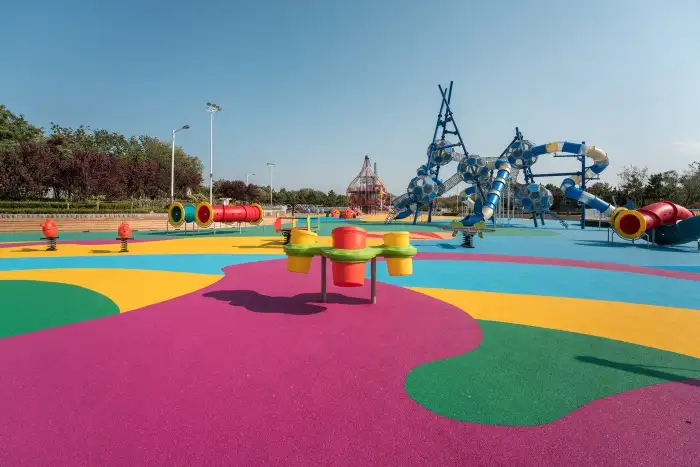
Rizhao Wanpingkou Children's Sports Park — Rizhao, China
Project type: outdoor children's sports and play area. Buyer problem addressed: coordinate colorful surfacing across multiple play zones and equipment. Publicly available evidence: the children's playground solution page presents this project as a real-project image reference within its project references. What to take from the case: use it to review zoning and color direction; confirm the selected EPDM granules, PU binder, Base Layer and project structure separately for a new enquiry.
Taiwan customer playground application — Taiwan, China
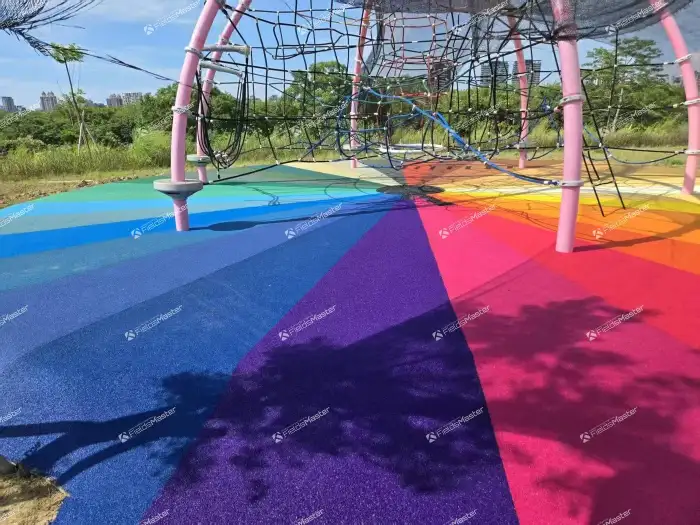
Project type: outdoor climbing and active-play area. Buyer problem addressed: plan multi-color surfacing around climbing equipment. Publicly available evidence: the children's playground solution page identifies customer-shared project photographs with a FieldsMaster watermark. What to take from the case: use the images to discuss color zoning and application direction; determine material models and system scope according to the new project's requirements.
For a project material review, provide:
- Playground layout and total surfacing area.
- Equipment list, fall-height information and the project's required safety or HIC criteria.
- Proposed Base Layer and EPDM Top Layer structure.
- Color plan, patterns, graphic elements and any school or brand color reference.
- Existing base information, drainage conditions and planned installation period.
- Delivery location, phased-delivery needs and any sample or technical-documentation request.
FieldsMaster can organize the enquiry at the scope the buyer needs: EPDM granules only, or EPDM granules together with PU binder and project-layer coordination. For either route, the confirmed color, particle-size range, sample, quantity and delivery requirements provide a clearer purchasing basis.
11. Technical Review
Technical review by Master Gong, Head of Laboratory at FieldsMaster. For this article, the technical review focuses on translating a buyer's input into a clearer material discussion: EPDM granule color and particle-size range, physical sample confirmation, PU binder and Base Layer inputs where required, preliminary quantity scope, and the requested material-document category. Final system selection, testing applicability and installation decisions remain subject to project drawings, the specified system, report scope and applicable requirements.
12. FAQ
How thick should EPDM be for a playground?
In the FieldsMaster playground reference structures, the visible EPDM Top Layer is 10 mm. The Base Layer thickness is adjusted around the required fall height, HIC performance, selected system and project specification. Final thickness must be confirmed for the complete project structure rather than selected from a generic rule.
Is EPDM safe for children's playgrounds?
EPDM granules can be used within a specified playground surface system. Safety performance depends on the complete installed structure, including the Base Layer, fall-height requirement, tested-system scope, installation quality and applicable project requirements.
How do I order EPDM granules for a playground?
Start with the intended playground application, selected color or blend direction, particle-size range, required quantity and destination. Use the Color Card and Color Mix Tool to select the visual direction, request a physical sample if needed, then submit an EPDM-granules-only request through Products Quotation or a layered project requirement through Project Quotation.
How many colors are available for EPDM playground granules?
FieldsMaster provides 114+ standard EPDM colors for playground color and graphic planning. A buyer can compare colors through the Color Card, test a preferred mix in the Color Mix Tool, then request a physical sample before confirming the material order.
What is HIC in playground surfacing?
HIC is a measure used in impact-attenuation assessment. It should be considered together with the required fall height, the specified system and the scope of any relevant test report.
Choose the right next step for your enquiry. Different buyers need different scopes, so start from the route that matches yours:
- EPDM granules only — confirm color, particle-size range, quantity and destination through Products Quotation.
- Need a physical mixed-color reference first — request free samples after selecting a color or blend direction.
- Have drawings, fall-height inputs or layer requirements — submit the project scope through Project Quotation.
Review the complete children playground surfacing solutions page before finalizing the material enquiry; the confirmed color, particle-size range, sample, quantity and delivery requirements then form a clearer purchasing basis.