

What EPDM Granule Sizes and Distributions Mean for Playground Surface Safety and Durability
When we think about playground safety, what often comes to mind are soft surfaces designed to cushion falls. But have you ever considered the tiny, yet mighty, components that make these surfaces so effective? Today, we're diving deep into the world of Ethylene Propylene Diene Monomer (EPDM) granules, exploring how their size and distribution play a crucial role in making playgrounds safe, durable, and fun for everyone. Understanding the specifics of EPDM granule size and its distribution is key to creating excellent play environments. I'll walk you through how these seemingly small details make a big difference in a playground's safety and how long it lasts.
Key Takeaways
- Granule Size Matters: The size of EPDM granules (e.g., 0.5-2mm, 1-3.5mm) directly influences the playground surface's cushioning, firmness, and porosity. Smaller granules create a denser, firmer surface, while larger ones can offer more bounce but may affect density.
- Distribution is Crucial: A uniform distribution of granules is essential for consistent shock absorption across the entire play area. Uneven distribution can create hard spots, posing safety risks and leading to premature wear and tear.
- Safety Standards are Non-Negotiable: The choice of granule size and the final installation must meet critical safety standards like ASTM F1292, which measures a surface's ability to absorb impact and reduce head injuries. The Critical Fall Height (CFH) of the play equipment dictates the required performance of the surface.
- Quality Equals Longevity: High-quality, virgin EPDM granules offer superior UV stability, colorfastness, and mechanical resilience compared to recycled alternatives. This translates to a longer lifespan and better long-term value, resisting cracking and degradation from weather exposure.
- Binder and Installation are Key: The type of polyurethane binder used (aromatic vs. aliphatic) and the expertise of the installation crew are just as important as the granules themselves. Proper installation ensures the system's integrity, durability, and safety.
Unpacking EPDM Granules: What Their Size and Distribution Truly Mean
The performance of a playground surface is a science. It relies on the careful engineering of its components, where EPDM granules are the star players. But to truly appreciate their role, we must look beyond their bright colors and bouncy feel. The specific size of these granules and the uniformity of their spread are engineering decisions that dictate everything from fall protection to the surface's ability to withstand years of play and weather.
Defining EPDM Granules: More Than Just Tiny Rubber Pieces
At a glance, EPDM granules might look like simple bits of colored rubber, but they are a high-performance material engineered for specific functions. EPDM is a type of synthetic rubber, a terpolymer of ethylene, propylene, and a diene-component. This chemical makeup gives it unique properties that make it an ideal choice for demanding environments like playgrounds, running tracks, and other recreational surfaces.
Exploring the Origins of High-Quality EPDM Granules
The story of EPDM granules begins not on the playground, but in the laboratory. EPDM is a synthetic rubber created through a sophisticated process called polymerization. Raw materials, primarily ethylene and propylene, are chemically bonded with a specific diene monomer. This process is conducted using a catalyst in a solution, which allows for precise control over the polymer's structure and molecular weight. The resulting EPDM polymer has a saturated backbone, which is the key to its exceptional resistance to outdoor elements.
This raw polymer is then compounded with other ingredients, such as oils, fillers, and, most importantly, pigments that give the granules their vibrant, lasting color. The compound is vulcanized (cured) to create a stable, durable rubber, which is then mechanically processed into small, consistently sized particles through grinding and sieving. This meticulous manufacturing process ensures that high-quality, virgin EPDM granules are pure, free from contaminants like metals or fibers often found in recycled tire rubber, and possess uniform physical properties.
Why EPDM Granules Are Preferred for Performance and Safety
The preference for EPDM in playground surfacing isn't accidental; it's a result of its superior material properties that directly translate to enhanced safety and longevity. When compared to other options like SBR (Styrene-Butadiene Rubber), which is often derived from recycled tires, virgin EPDM stands out. Here’s why:
- Superior Safety and Purity: Virgin EPDM granules are non-toxic and hypoallergenic, making them the safest option for areas where children have direct skin contact. Unlike recycled tire crumb (SBR), high-quality EPDM does not contain harmful substances like Polycyclic Aromatic Hydrocarbons (PAHs) or heavy metals. This purity ensures peace of mind for parents and facility managers.
- Exceptional UV and Weather Resistance: One of EPDM's most significant advantages is its outstanding resistance to UV radiation, ozone, and extreme temperatures. While SBR and other materials may fade, harden, or crack over time with sun exposure, EPDM maintains its color and elasticity, ensuring the surface doesn't become brittle and unsafe.
- Vibrant, Long-Lasting Color: The color in EPDM granules is integrated throughout the particle during manufacturing, not just coated on the surface. This means the colors remain vibrant and won't wear off or stain clothing, even after years of use. This contrasts sharply with surface-dyed SBR, which is known to fade relatively quickly.
- Excellent Elasticity and Shock Absorption: EPDM has remarkable elasticity, which is key to its role in shock absorption. When a child falls, a properly installed EPDM surface compresses to dissipate the impact energy, significantly reducing the risk of serious injury. Its flexible nature ensures it provides consistent fall protection over many years.
- Durability and Low Maintenance: The combination of weather resistance and robust physical properties gives EPDM surfaces a long lifespan, often 15 years or more with proper care. A seamless, poured-in-place installation eliminates trip hazards from shifting tiles or displaced loose-fill materials, and requires minimal upkeep compared to sand or wood chips.
The Fundamental Impact of EPDM Granules Size on Surface Mechanics
The size of an EPDM granule is not just a dimensional attribute; it's a critical variable that defines the mechanical behavior of the entire playground surface. The interplay between granule size, shape, and the binder creates a composite material whose properties can be fine-tuned for specific safety and performance goals.
How Different Granules Sizes Affect Cushioning and Impact Absorption
The relationship between granule size and cushioning is a matter of physics and material science. When granules are mixed with a binder and compacted, the size of the granules determines the final density and internal structure of the surface.
Finer Granules (e.g., 0.5-1.5mm): These smaller particles pack together more tightly, creating a denser and firmer surface. There is less void space between the granules, which results in less compression under impact. While this provides a very smooth and stable surface, ideal for running tracks or creating detailed graphic inlays, it offers less inherent shock absorption on its own. To achieve high fall ratings, a surface with fine granules in the top layer typically relies heavily on a thick, shock-absorbing base layer made of larger, recycled rubber pieces.
Larger Granules (e.g., 2-4mm): Larger granules create more interstitial void space within the matrix. This structure allows for more compression when an impact occurs. The granules can shift and deform into these voids, dissipating energy more effectively. This makes surfaces with larger granules inherently better at absorbing impact. Therefore, a mix with larger granules in the wear layer can contribute more significantly to the overall fall protection of the system, sometimes allowing for a slightly thinner base layer compared to a system using very fine top-layer granules to achieve the same safety rating.
Mixed Granule Sizes: Often, an optimal balance is achieved by using a specific blend of granule sizes. This allows manufacturers and installers to fine-tune the surface properties, achieving a desired combination of smoothness, durability, porosity, and impact absorption tailored to the specific needs of the playground.
The ability of a rubber material to return to its original shape after being compressed is known as its compression set. EPDM has a low compression set, meaning it recovers well from impacts, which is crucial for maintaining its protective qualities over the long term.
Understanding Consistent Granules Distribution for Optimal Functionality
Even with the perfect granule size and highest quality materials, a playground surface can fail if the granules are not distributed properly during installation. Uniform particle distribution is critical for creating a homogenous surface with predictable and reliable performance. An experienced installation crew is essential for achieving this consistency.
When a batch of granules with an inconsistent size distribution (containing too many fine or oversized particles) is mixed and laid, it can lead to several problems:
- Inconsistent Density: Areas with a higher concentration of fine particles will be denser and harder, while areas with more large granules will be softer. This creates an uneven surface with unpredictable shock absorption, compromising the safety of the entire play area.
- Weak Spots: Poor distribution can prevent the polyurethane binder from evenly coating all the granules. Patches with insufficient binder become weak spots that are prone to crumbling and granule loss, leading to premature surface failure.
- Poor Aesthetics: An uneven spread of colored granules results in a blotchy, unprofessional finish. For projects involving intricate designs or logos, consistent distribution is paramount for a clean and sharp final appearance.
- Compromised Drainage: Uniform void spacing is necessary for proper water permeability. Inconsistent distribution can create dense, non-porous patches where water can puddle, leading to slip hazards and potential moisture damage to the surface and sub-base over time.
Therefore, ensuring that the EPDM granules are thoroughly mixed with the binder and troweled to a consistent thickness and density by skilled technicians is just as important as selecting the right materials. A successful installation depends on the synergy between quality materials and expert craftsmanship.
Common EPDM Granules Size Specifications and Their Performance Implications
The specification of EPDM granules is a precise science. The industry has developed standard size ranges that are engineered to meet specific performance criteria for various applications, from professional running tracks to community playgrounds. Understanding these specifications is the first step for architects, specifiers, and buyers to ensure the final product meets their expectations for safety, performance, and aesthetics.
A Look at Standard EPDM Granules Sizes in Playground Surfacing
While custom sizes can be produced, the vast majority of playground projects utilize a few common EPDM granule size ranges. The choice depends on the intended use, desired texture, and performance requirements of the surface layer.
Typical Ranges for EPDM Granules (e.g., 0.5-2mm, 1-3.5mm, 3-6mm)
The granulation process allows manufacturers to produce EPDM particles within specific size ranges, or "cuts." These are then sieved and sorted to ensure they meet specification. The most common ranges used for playground and recreational surfacing include:
- 0.5mm - 1.5mm: This is a fine granule size. It creates a very smooth, dense, and tightly packed surface. It is often preferred for applications requiring intricate graphic designs, logos, or for creating the smoothest possible finish on walkways and multi-use game areas. Due to the high surface area of the fine particles, this size range typically requires a higher ratio of binder to ensure all granules are fully coated.
- 1.0mm - 3.5mm (or 1-3mm): This is arguably the most popular and versatile size range for the top wear layer of poured-in-place playground surfaces. It offers an excellent balance between a relatively smooth texture, good durability, and efficient installation. This size provides a good combination of aesthetic appeal and performance, making it a reliable standard for general play areas.
- 2.0mm - 4.0mm: This slightly coarser granule is also widely used, particularly in applications where enhanced shock absorption and porosity are desired. The larger particle size creates more void space, which can contribute to better drainage and a softer feel underfoot. It is an excellent choice for general playground areas and is also frequently specified for running tracks to provide a balance of firmness and cushioning.
- 3.0mm - 6.0mm: This is a coarse granule size. It is less common for the top wear layer of a standard playground but is often used as infill for artificial turf systems. Its larger size helps it stay in place between the turf fibers, providing stability, cushioning, and ballast to the system.
Here is a table summarizing the characteristics and best uses for these common EPDM granule sizes:
| Granule Size (mm) | Key Characteristics | Best Applications | Considerations |
|---|---|---|---|
| 0.5 - 1.5 | Very smooth, dense finish, tight packing, high aesthetic detail. | Intricate logos, graphic inlays, topcoats on tracks, very smooth walkways. | Requires more binder, may have lower porosity. |
| 1.0 - 3.5 | Excellent balance of smooth texture and durability, versatile, good coverage. | General playground wear layers, multi-sport courts, standard high-traffic areas. | The industry standard for a good reason; reliable and effective. |
| 2.0 - 4.0 | More textured feel, excellent porosity and drainage, enhanced cushioning. | General play areas, running tracks, regions with high rainfall. | Slightly more textured appearance than finer granules. |
| 3.0 - 6.0 | Coarse texture, maximum drainage, excellent stability as a loose-fill component. | Infill for artificial turf fields, some specialized drainage or base layer applications. | Not typically used for poured-in-place top layers due to its coarse texture. |
How Controlled Granules Size Ensures Product Quality
Reputable manufacturers of EPDM granules don't just grind rubber; they engineer particles. A critical aspect of quality control is ensuring a tight and consistent particle size distribution (PSD) within each batch. A product labeled "1-3.5mm" should not contain significant amounts of dust (fines) or oversized chunks.
This control is achieved through a meticulous process of screening and sieving. After the initial granulation, the particles are passed through a series of screens with specific mesh sizes. This sorting process ensures that what gets packaged is a consistent product that will perform predictably.
Why is this so important for quality?
- Predictable Binder Consumption: As noted, finer particles have more total surface area and absorb more of the costly polyurethane binder. A batch with unexpected "fines" can cause an installer to run out of binder, leading to project delays and cost overruns. Consistent sizing allows for accurate calculation of material needs.
- Uniform Curing and Strength: A homogenous mix of granules and binder cures more evenly, resulting in a surface with consistent tensile strength and durability. Inconsistent batches can lead to weak spots that are susceptible to tearing or crumbling.
- Guaranteed Performance: Whether it's the shock absorption for a playground or the specific grip and texture for a running track, the performance characteristics are directly tied to the particle size. Strict quality control on sizing is how a manufacturer can guarantee their product will meet specified safety and performance standards once installed.
Professionals can verify the quality of a granule batch by requesting a sieve analysis report. This document shows the exact percentage of material retained on a series of different-sized sieves, providing a clear picture of the particle size distribution and confirming it matches the product specification.
The Critical Role of Uniform Granules Distribution for Safety and Playability
Having high-quality granules of the correct size is only half the battle. The final step—installation—is where the expertise of the crew becomes paramount. The uniform distribution of these granules during the pour-in-place process is what ultimately creates a safe, functional, and durable surface. This involves not just spreading the material, but expertly mixing, pouring, and troweling it to achieve a seamless, uniformly dense mat.
Achieving Ideal Shock Absorption Through Consistent EPDM Granules Spreading
The primary purpose of a playground safety surface is to cushion falls and prevent life-threatening head injuries. The international standard for measuring this is the Head Injury Criterion (HIC) test, as defined by standards like ASTM F1292. This test involves dropping an instrumented headform onto the surface and measuring the force of the impact. The surface passes if the G-max (peak deceleration) and HIC values are below a specific threshold.
A consistently distributed layer of EPDM granules is fundamental to passing these tests across the entire use zone of a playground.
- Uniform Thickness and Density: An experienced installer meticulously trowels the EPDM and binder mixture to a specified, consistent depth. This ensures that every square foot of the surface has the same density and thickness, providing predictable impact attenuation no matter where a child might fall.
- Eliminating Hard Spots: Uneven distribution leads to hard spots—areas where the material is overly compacted or too thin. These spots will fail an HIC test and represent a significant safety hazard. A fall on a hard spot can be nearly as dangerous as a fall on concrete.
- System Integrity: The safety surface is a system, typically comprising a shock-absorbing base layer (often made of recycled SBR rubber) and a durable EPDM wear layer. Consistent application ensures these two layers work together as designed to dissipate the energy of a fall effectively. If the EPDM layer is uneven, it can create shear stress and compromise the bond to the base layer, leading to delamination and failure.
Third-party testing of a newly installed surface is the ultimate verification that the materials and installation have come together to create a playground that meets the required safety standards for its designated Critical Fall Height.
Enhancing Grip and Reducing Fatigue with Proper Granules Distribution
Beyond fall safety, a well-installed EPDM surface significantly enhances the overall playability and comfort of the area. A consistent, uniform surface contributes to this in two key ways:
- Enhanced Grip and Slip Resistance: A properly troweled EPDM surface has a uniform, slightly textured finish that provides excellent grip. This slip resistance is a critical safety feature, especially in wet conditions or in areas with water play features. An uneven distribution can create slick, binder-rich spots or loose, crumbly areas, both of which can be hazardous and lead to slips and falls. EPDM's natural slip resistance helps ensure children can run and play with confidence.
- Anti-Fatigue Properties: The inherent elasticity of a poured rubber surface provides a comfortable cushion underfoot. This helps to reduce stress and fatigue on the joints of children playing for long periods, as well as on the parents and caregivers supervising them. The surface absorbs the micro-shocks of running and jumping, creating a much more pleasant and forgiving environment than hard surfaces like asphalt or concrete. A consistent surface ensures these ergonomic benefits are felt equally across the entire playground.
Connecting EPDM Granules Quality and Size to Long-Term Durability
The durability of a playground surface is a measure of its ability to withstand the trifecta of constant use, harsh weather, and time. The quality and size of the EPDM granules are foundational to this long-term resilience. Investing in high-quality materials from the outset is the most effective way to ensure a long and useful life for the playground, minimizing costly repairs and premature replacement.
UV Stability and Mechanical Resilience of EPDM Granules
The inherent chemical makeup of EPDM is its greatest asset for long-term durability. The saturated polymer backbone of EPDM rubber is exceptionally resistant to attack from UV radiation and ozone, which are the primary culprits of degradation in many other types of rubber. While materials like natural rubber or SBR have double bonds in their polymer chains that are easily broken by UV light, EPDM's structure is far more robust. This means:
- No Cracking or Brittleness: Over years of sun exposure, an EPDM surface will not become hard, brittle, or develop the surface cracks that plague less stable materials. It retains its elasticity.
- Color Stability: High-quality EPDM granules are formulated with UV-stable pigments that are chemically bonded within the rubber. This ensures that the playground remains vibrant and does not "chalk" or fade significantly over its lifespan. Even light colors can remain stable when formulated correctly.
- Mechanical Resilience: The ability to withstand repeated impacts without breaking down is key. EPDM has good tensile strength (resistance to being pulled apart) and tear resistance. The size of the granules plays a role here; a surface made from well-bonded, appropriately sized granules forms a strong, unified matrix that can handle the dynamic stresses of constant play, from running and jumping to the scuffing of shoes. Harder granules (with a higher Shore A durometer reading) offer more wear resistance, making them suitable for very high-traffic areas.
Why Purity and Consistent EPDM Granules Size Lead to Extended Lifespan
A long-lasting playground surface starts with pure, high-quality materials. For EPDM surfaces, this means using virgin EPDM granules with a consistent and controlled size.
- Purity of Virgin EPDM: Virgin EPDM granules are manufactured from new synthetic polymer, not recycled materials. This is a critical distinction because it ensures there are no contaminants, such as metal fragments, fabric, or other rubbers, which are often found in recycled tire granules (SBR). These impurities can compromise the structural integrity of the surface and create safety hazards. More importantly, dust and other fine, non-EPDM particles can interfere with the chemical bonding process. They absorb the polyurethane binder without contributing to the structural strength, effectively "stealing" adhesive from the granules and creating a weaker surface that is prone to crumbling.
- The Role of Consistent Sizing: A batch of granules with a consistent particle size distribution (PSD) is crucial for longevity. When granules are of a uniform size, they pack together predictably. This allows the polyurethane binder to form a continuous and robust matrix, ensuring every granule is securely locked in place. Inconsistent sizing, with too many large and small particles mixed together, creates voids and dense spots. This leads to uneven stress distribution, and weak points in the surface that will break down first under the mechanical stress of play, leading to cracking and granule loss.
By investing in high-purity, virgin EPDM granules with a tightly controlled size range, you are laying the groundwork for a playground surface that will maintain its safety features and vibrant appearance for many years. You can review available options on a comprehensive 产品页 (Product Page) to see the range of high-quality materials offered.
Selecting the Right EPDM Granules Size and Distribution for Specific Playground Needs
Choosing the correct EPDM granule specification is not a one-size-fits-all decision. It's a critical design choice that requires balancing safety regulations, aesthetic goals, climate considerations, and budget. A thoughtful selection process ensures the final playground surface is not only beautiful and durable but, most importantly, safe for its intended users. This involves a careful analysis of the play equipment, the expected user group, and the local environment.
Tailoring EPDM Granules Selection for Optimal Impact Absorption and Safety Standards
The fundamental purpose of a playground safety surface is to prevent life-threatening head injuries from falls. The effectiveness of the surface in this role is scientifically measured and regulated by stringent national and international standards. The selection of EPDM granules must be directly guided by these safety requirements.
Matching Granules Size to Critical Fall Heights and Certification Requirements
The most important variable in playground design is the Critical Fall Height (CFH). This is the maximum vertical distance from which a child could fall from a designated play surface on a piece of equipment. Every piece of commercial playground equipment has a manufacturer-specified CFH. Safety standards, like ASTM F1292 in the United States, mandate that the surfacing installed within the equipment's use zone must have a certified HIC rating that meets or exceeds this CFH.
The relationship between the EPDM surface system and the CFH is direct:
- Higher Falls, Thicker Surfaces: The greater the CFH of the equipment, the more shock-absorbent the surface needs to be. For poured-in-place systems, this is typically achieved by increasing the thickness of the shock-absorbing base layer. For example, a surface rated for a 4-foot fall might have a total thickness of 2 inches, while a surface rated for an 8-foot fall could require a total system thickness of 4 inches or more.
- Granule Size and System Design: The size of the EPDM granules in the wear layer is part of this system-wide calculation. While the base layer provides the bulk of the shock absorption, the top layer contributes as well. A system using larger EPDM granules (e.g., 2-4mm) in the wear layer may achieve a specific CFH rating with a slightly different base layer thickness compared to a system using finer granules (e.g., 1-3mm).
- Certification is Key: Reputable surfacing manufacturers provide third-party test reports certifying their systems' performance at various thicknesses. A playground designer must match the equipment's CFH to a surfacing system certified to protect for that fall height. It is not enough to simply choose a granule size; one must select a complete, tested system. A surface is only compliant if it has documentation proving it meets ASTM F1292 standards for the required fall height.
The Importance of Adhering to International and National Standards for EPDM Granules
Adherence to established safety standards is not optional—it is a legal and ethical requirement for anyone involved in designing, building, or operating a public playground. These standards provide a unified framework for ensuring safety and are often cited in legal cases.
Key standards include:
- ASTM F1292 (United States): This is the "Standard Specification for Impact Attenuation of Surfacing Materials Within the Use Zone of Playground Equipment." It defines the testing procedure for measuring HIC and G-max to determine a surface's Critical Fall Height. Compliance is mandatory for public playgrounds.
- EN 1177 (Europe): This is the European equivalent of ASTM F1292. It also specifies the test method for determining the impact attenuation of playground surfacing and defining the CFH. While the principles are similar, there can be slight differences in methodology, so it's important to adhere to the standard relevant to the project's location.
- CPSC Handbook for Public Playground Safety (Publication #325): The U.S. Consumer Product Safety Commission provides these guidelines, which are considered the industry benchmark for safe playground design and operation. The handbook references ASTM standards and provides recommendations on everything from use zones to maintenance schedules.
- IPEMA Certification: The International Play Equipment Manufacturers Association (IPEMA) offers a third-party certification program. An IPEMA seal verifies that a manufacturer's surfacing system has been independently tested and certified to conform to ASTM F1292 standards. Specifying IPEMA-certified materials provides an extra layer of assurance that the product meets established safety benchmarks.
Choosing EPDM granules and surfacing systems that are certified to these standards is a crucial step in mitigating liability and, more importantly, protecting children from preventable injuries.
How EPDM Granules Size Influences Playground Design and Aesthetics
Beyond the critical safety functions, EPDM granules offer unparalleled design flexibility. The granule size and color are powerful tools for landscape architects and designers to create play spaces that are not just safe, but also engaging, imaginative, and visually stunning. This aesthetic dimension contributes significantly to the overall value and appeal of a play environment.
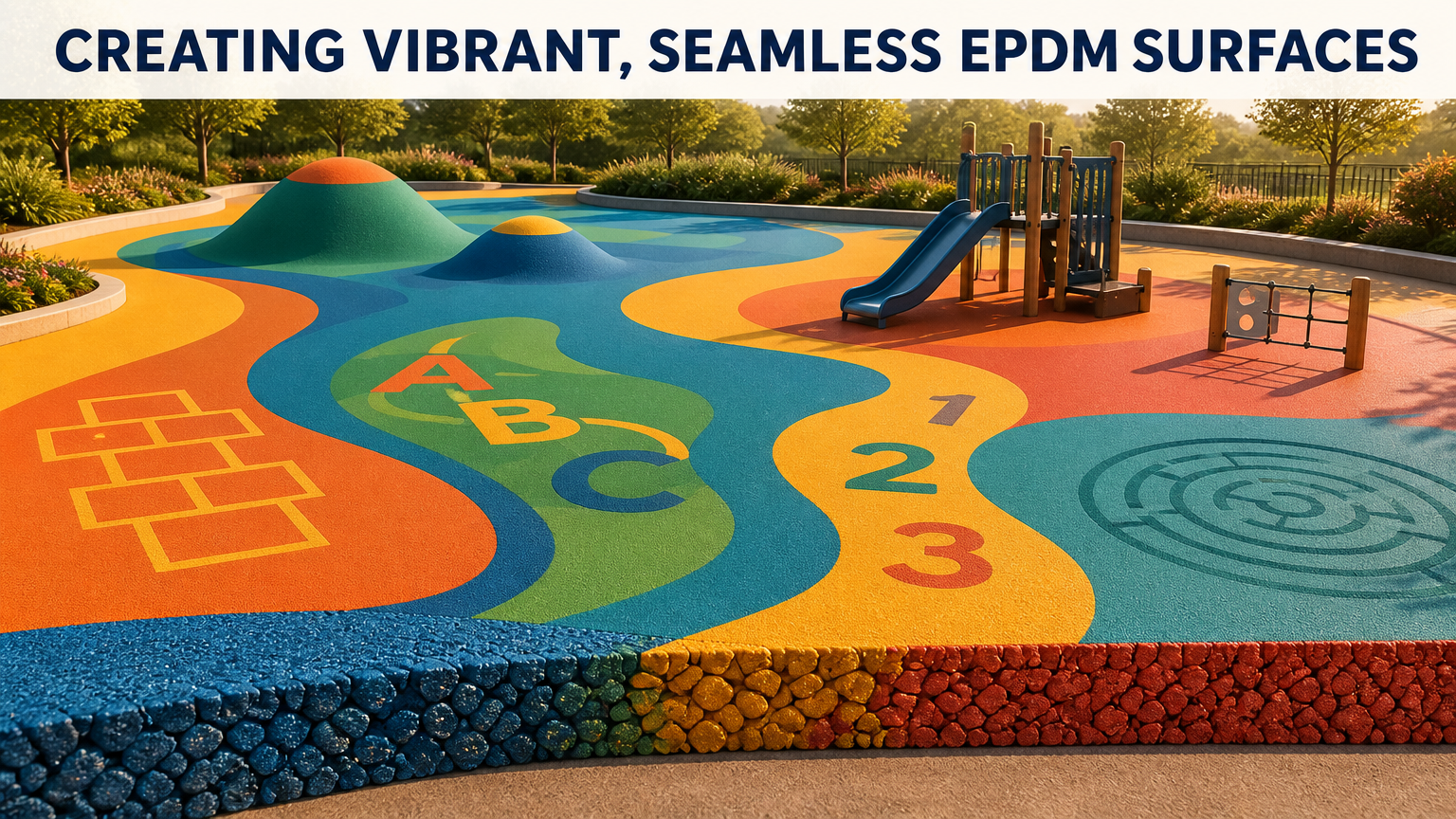
Creating Vibrant and Seamless Surfaces with Colored EPDM Granules
The single greatest aesthetic advantage of a poured-in-place EPDM surface is its ability to create a seamless, uniform canvas. Unlike tiles with distracting grid lines or loose-fill materials that look untidy, a poured surface offers a clean, monolithic appearance that elevates the design of any space. This seamless quality is the foundation for incredible design creativity.
Because EPDM granules are available in a wide spectrum of bright, UV-stable colors, designers are no longer limited to monotonous browns and blacks. This opens up a world of possibilities:
- Themed Environments: Playgrounds can be transformed into immersive worlds. A blend of blues and greens can create an aquatic theme with flowing rivers and islands, while yellows and oranges can evoke a desert landscape or a sunny beach.
- Branding and Identity: Schools and communities can incorporate their logos, mascots, or colors directly into the playground surface, fostering a sense of identity and pride.
- Play and Learning: The surface itself can become part of the play. Hopscotch grids, four-square courts, alphabets, number lines, and intricate mazes can be permanently inlaid, encouraging both physical activity and learning.
- 3D Elements: The design isn't limited to two dimensions. Skilled installers can create gentle mounds, hills, and even playful 3D shapes that integrate directly into the surface, adding a new level of interactivity and imaginative play.
To explore the endless creative possibilities, designers can use a 混色页面 (Color Mix Page) to experiment with different color combinations and see how they can bring a unique vision to life. The choice of granule size can influence the final look; finer granules (e.g., 1-3mm) allow for sharper, more detailed graphic work, while slightly larger granules (e.g., 2-4mm) can provide a more pronounced, textured appearance.
Distinguishing Between EPDM Granules and Rubber Buffings for Different Textures
It is important for designers and buyers to understand the terminology used for different rubber surfacing materials, as "EPDM granules" and "rubber buffings" refer to distinctly different products with different textures and performance characteristics.
EPDM Granules: As discussed throughout this article, these are high-purity, virgin synthetic rubber particles. They are specifically manufactured for surfacing applications. They are characterized by their consistent, roughly spherical or cubical shape, uniform size, and through-and-through color. This controlled manufacturing process results in a predictable, high-performance material with a refined texture.
Rubber Buffings (or SBR Crumb/Granules): This material is a byproduct of the tire recycling industry. "Buffings" specifically refer to the shavings or slivers of rubber that are ground off the tread of used truck tires before they are retreaded. This material is SBR (Styrene-Butadiene Rubber), not EPDM. It is less expensive but has a different set of properties:
- Texture and Shape: Buffings are more irregular and sliver-like in shape compared to the granular form of EPDM. This creates a different, often coarser, surface texture.
- Color: SBR is naturally black. Colored buffings are typically surface-coated with a pigment, which can wear off over time, revealing the black rubber underneath. This is different from the integral color of EPDM.
- Performance: SBR does not have the same level of UV and ozone resistance as EPDM, meaning it can degrade and fade more quickly in outdoor applications.
- Application: Due to its excellent shock absorption and lower cost, SBR is the standard material used for the thick, black base layer in a two-layer poured-in-place system. It provides the "cushion," while the EPDM top layer provides durability, color, and UV protection.
In summary, while both are "rubber," virgin EPDM granules are the premium, engineered material for the visible top wear layer, offering superior aesthetics and longevity. Rubber buffings (SBR) are the workhorse material for the hidden base layer, providing cost-effective impact absorption.
Considering Climate and Environmental Factors in EPDM Granules Choice
A playground surface is constantly exposed to the elements. Its ability to perform reliably in a specific local climate—whether that involves intense sun, heavy rainfall, or freeze-thaw cycles—is a critical factor in its long-term success. EPDM is exceptionally well-suited for a wide range of climates, but certain considerations can help optimize the selection for a particular environment.
The Impact of UV Exposure, Temperature, and Precipitation on EPDM Granules
EPDM rubber is famed for its exceptional weather resistance, making it a prime material for outdoor surfaces that must endure decades of environmental stress. Its performance is rooted in its stable chemical structure.
- UV Exposure: The saturated polymer backbone of EPDM is highly resistant to degradation from ultraviolet (UV) radiation. Unlike other rubbers that can become brittle and crack, high-quality EPDM maintains its elasticity and color. However, not all colors perform equally. Brighter organic pigments like some yellows, oranges, and purples can be more susceptible to fading over time than more stable inorganic pigments. For playgrounds in high-sun areas, selecting colors with proven UV stability is crucial for long-term aesthetic appeal.
- Temperature Extremes: EPDM performs exceptionally well across a wide temperature range, typically from -40°F to over 250°F (-40°C to 121°C). In hot climates, it resists softening and becoming sticky. While dark-colored surfaces can absorb significant heat, lighter EPDM colors can help keep the surface temperature lower. In cold climates, EPDM's excellent flexibility prevents it from becoming brittle and cracking, a common failure point for more rigid materials during freeze-thaw cycles.
- Precipitation and Porosity: A properly installed poured-in-place EPDM surface is porous, allowing water to drain through it into the sub-base below. This is a significant advantage in rainy climates, as it prevents puddles from forming on the surface, which reduces slip hazards and allows the playground to be used again quickly after a storm. This porous nature also helps mitigate damage from freeze-thaw cycles, as water is less likely to become trapped within the surface, freeze, and cause expansion damage.
Selecting Climate-Optimized EPDM Granules for Reduced Maintenance
By making informed choices based on the local climate, designers and facility managers can significantly reduce future maintenance burdens and extend the life of the playground surface.
For Hot, Sunny Climates (e.g., Arizona, UAE):
- Color Choice: Prioritize light and UV-stable colors. While black has the best inherent UV resistance due to its carbon black pigment, it absorbs immense heat and can make surfaces dangerously hot for children. Light grays, beiges, and specially formulated UV-resistant light colors are a much better choice. Dark reds and dark greens made with iron oxide pigments also offer excellent long-term color stability. Avoid bright organic colors like certain yellows and oranges for large surface areas, as they may fade faster under intense, prolonged UV exposure.
- Binder Choice: Always specify a high-quality, aliphatic polyurethane binder. It is non-yellowing and will protect the integrity of the light-colored granules, whereas a cheaper aromatic binder will turn amber in the sun, ruining the aesthetic.
For Rainy Climates (e.g., Pacific Northwest, Southeast Asia):
- Porosity is Key: The primary goal is to ensure excellent drainage to prevent puddles. A surface specified with a slightly larger granule size (e.g., 2-4mm) will have greater porosity, allowing water to drain through it quickly.
- Sub-base Design: Just as important is a properly prepared sub-base (e.g., compacted stone) that is graded to carry water away from the playground area. A porous top surface is useless if the water has nowhere to go underneath.
For Climates with Freeze-Thaw Cycles (e.g., Northeast, Midwest):
- Flexibility and Drainage: EPDM's natural flexibility is a major advantage, allowing it to expand and contract without cracking. A porous system is crucial here to prevent water from being trapped within the surface, where it can freeze, expand, and cause delamination or "heaving." Ensuring both the EPDM layer and the sub-base drain efficiently is the best defense against winter damage.
By matching the EPDM granule properties and overall system design to the specific environmental challenges, you create a surface that is not only safer on day one but also requires less intervention and repair over its entire lifespan.
The Economic Aspects: Balancing EPDM Granules Size, Performance, and Cost
While the initial investment for a high-quality poured-in-place EPDM surface can be higher than for other options like wood chips or loose-fill rubber, a proper economic analysis must consider the total cost of ownership over the surface's entire lifespan. Factors like durability, maintenance requirements, and longevity often reveal that a premium EPDM system offers superior long-term value. Granule size, quality, and binder type are all significant variables in this economic equation.
Initial Investment vs. Long-Term Value of Quality EPDM Granules
The upfront cost of a playground surface is a major consideration for any project budget. However, focusing solely on the initial price tag can be a costly mistake. The true value of a surface is found in its ability to perform safely and reliably for many years with minimal ongoing expense.
Why Virgin EPDM Granules Often Outperform Recycled Alternatives like TPV
In the world of high-performance rubber granules, another material often enters the conversation: TPV, or Thermoplastic Vulcanizate. While outwardly similar to EPDM, TPV has a different chemical makeup that results in a distinct set of properties. Understanding the trade-offs is essential for making a sound investment decision.
EPDM (Ethylene Propylene Diene Monomer): This is a thermoset rubber. Its chemical bonds are set permanently during the manufacturing (vulcanization) process.
- Pros: EPDM has a long and proven track record of over 30 years in outdoor applications. It offers superior elasticity, which is crucial for impact absorption, with some sources stating it can stretch up to 50% more than TPV before breaking. Its surface porosity also allows for an excellent and strong bond with polyurethane binders.
- Cons: While high-quality EPDM has excellent UV resistance, lower-quality formulations or certain colors can be susceptible to fading or "chalking" over time.
TPV (Thermoplastic Vulcanizate): This is a thermoplastic elastomer, which means it can be melted and reprocessed.
- Pros: TPV is often cited for having even better UV resistance and color stability than standard EPDM, meaning colors may stay vibrant for longer. It is also recyclable, which can be an advantage for sustainability-focused projects.
- Cons: TPV is generally less elastic and can be more brittle than EPDM. This can make it more susceptible to shedding or cracking under stress. While it has a less porous surface, which might mean using less binder, this can also result in a weaker bond compared to EPDM. TPV also typically comes at a higher initial cost, with some estimates putting it at a 20-40% price premium over EPDM.
The Verdict for Long-Term Value: For most playground applications where safety, impact absorption, and proven durability are the top priorities, high-quality, virgin EPDM remains the superior choice. Its greater elasticity directly translates to better safety performance, and its strong bond with binders leads to a more durable surface. While TPV has advantages in colorfastness and recyclability, EPDM's three-decade track record of performance and its superior mechanical properties for safety make it the better long-term value proposition for playgrounds.
Understanding the Lifespan Differences Between EPDM and Other Rubber Materials
The expected lifespan of a playground surface varies dramatically depending on the material chosen. While some options are cheaper upfront, they often require more frequent and costly replacement, leading to a higher total cost of ownership.
- High-Quality Poured EPDM Surface: A professionally installed EPDM surface using high-quality virgin granules and a proper binder system has an expected lifespan of 10 to 15 years, and sometimes up to 20 years with excellent maintenance. While the initial investment is higher, the long service life and low annual maintenance costs often make it the most economical choice over the long run.
- SBR / Recycled Rubber Surfaces: When recycled SBR is used as the top wear layer (often in a single-layer system or as colored SBR), its lifespan is significantly shorter. Due to lower UV resistance, these surfaces can begin to fade, harden, and crack within 3 to 5 years, and may need full replacement in as few as 6 to 10 years.
- Engineered Wood Fiber (EWF): This is a popular loose-fill option. While the material itself can last for many years, it requires significant annual maintenance. EWF compacts in high-traffic areas (like under swings and at slide exits) and decomposes over time, requiring annual "top-offs" to maintain the proper safety depth. These recurring material and labor costs add up significantly over the life of the playground.
- Pea Gravel / Sand: These are among the cheapest materials initially but have major drawbacks. They offer poor impact absorption compared to rubber or EWF, scatter easily, and can hide foreign objects or waste. Gravel can compact over time into a hard, unsafe surface. While the material itself is durable, maintaining a safe and clean play area is labor-intensive and challenging.
When comparing a 15-year lifecycle, the cost of repeatedly replenishing EWF or fully replacing a lower-quality rubber surface can easily exceed the initial higher cost of a premium EPDM installation.
The Influence of Binders and Installation Expertise on Overall EPDM Granules System Cost
The EPDM granules themselves are only one component of the final surface. The polyurethane (PU) binder that glues them together and the skill of the installation team are equally critical factors that heavily influence both the performance and the total cost of the project. Choosing the wrong binder or an inexperienced installer can undermine the entire investment.
Comparing Aromatic vs. Aliphatic Binders for EPDM Granules Applications
The binder is the unsung hero of the poured rubber system, but choosing the right type is a critical decision that impacts both color stability and cost. There are two main types of polyurethane binders used:
Aromatic Binders:
- Properties: Aromatic binders are the industry standard for most applications. They provide excellent bonding strength and are more cost-effective. However, their chemical structure contains benzene rings, which makes them susceptible to UV degradation. This causes them to "amber" or turn a yellowish color upon exposure to sunlight.
- Aesthetic Impact: This ambering effect is most noticeable on light or cool-colored granules. For example, a sky-blue surface can appear greenish, and white granules can look yellow. On dark colors like black, brown, or dark red, the effect is barely perceptible.
- Cost: They are significantly less expensive than aliphatic binders, often by as much as 50%.
Aliphatic Binders:
- Properties: Aliphatic binders do not contain the UV-sensitive benzene rings in their chemical structure. As a result, they are crystal clear and completely UV stable; they do not yellow over time. They are also generally more resistant to chemicals like chlorine.
- Aesthetic Impact: Because they do not amber, aliphatic binders are essential for projects using white, beige, grey, blue, or other light-colored granules where color fidelity is paramount. They ensure the final surface color is true to the color of the granules.
- Cost: They are considered a premium product and can be double the price of aromatic binders.
Making the Choice: The decision often comes down to balancing budget and aesthetics.
- Use Aromatic Binders When: The project uses dark-colored granules (black, brown, terracotta red), the budget is a primary constraint, and a slight ambering effect is acceptable.
- Use Aliphatic Binders When: The design features light or bright colors (especially blues, greys, and whites), color stability is non-negotiable, or the surface is for a pool deck or splash pad where chlorine resistance is needed.
While the initial cost is higher, investing in an aliphatic binder for a light-colored playground is crucial for achieving the desired long-term aesthetic and avoiding a discolored, yellowed surface.
The True Cost of Poor Installation: Mitigating Risks for EPDM Granules Surfaces
Hiring a low-bid, inexperienced installer is one of the quickest ways to turn a high-quality material investment into a failed project. While industry data suggests materials account for about 30% of a project's success, a staggering 70% depends on the quality of the installation. Even the best EPDM granules will fail if installed improperly. The cost of a poor installation isn't just the initial fee; it's the repeated, expensive repairs and the drastically shortened lifespan of the surface.
Common installation mistakes by untrained crews include:
- Improper Sub-base Preparation: Failing to ensure the concrete or asphalt sub-base is clean, dry, and properly graded is the leading cause of poured rubber failure. An uneven or contaminated base prevents the binder from adhering correctly, leading to delamination and an uneven final surface.
- Incorrect Binder-to-Granule Ratio: This is a critical error. Too little binder (e.g., below 18% by weight for the top layer) results in a weak surface that quickly starts to shed granules. Too much binder can create a dense, non-porous surface that doesn't absorb impact properly and can become slippery. Professional crews use precise weighing equipment, not guesswork.
- Ignoring Weather Conditions: Polyurethane binders are moisture-cured, and installing them in the rain or high humidity can cause a chemical reaction called micro-foaming. This creates bubbles in the surface, weakens the bond, and often leads to discoloration.
- Poor Troweling and Compaction: Skilled troweling is an art. Inexperienced workers can leave trowel marks, create uneven density, or fail to properly compact the material, resulting in visual defects and weak spots.
- Insufficient Depth: Installing the surface at a thickness that doesn't meet the certified depth for the playground's Critical Fall Height is a serious safety and liability risk.
The "true cost" of a bad installation includes patching crumbly sections, repairing cracks, and often, the premature and complete replacement of the entire surface, wiping out any initial savings and doubling the project cost. Mitigating this risk is simple: hire certified, experienced installers with a proven track record and verifiable references.
Maintenance and Longevity: Maximizing the Value of Your EPDM Granules Investment
A high-quality EPDM surface is a low-maintenance solution, but not a no-maintenance one. A simple, consistent routine of care and inspection can significantly extend the surface's functional life, protect its aesthetic appeal, and ensure it remains safe for years to come. This proactive approach maximizes the return on the initial investment.
Routine Care and Inspections to Extend the Life of EPDM Granules Surfaces
A well-maintained EPDM surface will deliver a longer life and better performance. A simple and regular maintenance program is the best way to protect your investment.
Routine Cleaning:
- Weekly/Monthly: Use a leaf blower or a soft-bristle broom to remove loose debris like leaves, dirt, sand, and twigs. This prevents organic matter from breaking down and clogging the pores of the surface, which is essential for good drainage.
- As Needed for Stains: For spills, mud, or other stains, clean the area promptly. Usually, a simple solution of water and a mild, pH-neutral detergent is sufficient. Gently scrub the area with a soft brush, then rinse thoroughly with a low-pressure water hose. Avoid harsh, solvent-based cleaners or high-pressure power washing, as these can damage the binder and dislodge granules.
Regular Inspections (Quarterly or Semi-Annually): A consistent inspection schedule helps you catch small problems before they become big, expensive ones. Walk the entire surface and look for:
- Cracks, Tears, or Holes: Pay special attention to high-wear areas like the exits of slides and under swings. Small damaged spots should be repaired promptly to prevent them from expanding.
- Lifting or Separated Seams: Check the perimeter of the surface and any seams between different colored sections to ensure they are still firmly bonded.
- Soft or Spongy Spots: This can indicate a problem with the sub-base, often caused by poor drainage. If water is pooling underneath the rubber, it can weaken the foundation.
- Granule Loss (Granulation): A small amount of loose granules can be normal, but if you notice significant areas where the surface is thinning or crumbling, it signals that the top wear layer is deteriorating.
- Drainage Issues: After a rainfall, check to see if water is draining properly or if it is pooling on the surface. Clogged pores can lead to standing water, which can accelerate degradation and create slip hazards.
By following a simple maintenance checklist, facility managers can ensure the playground remains in top condition, extending its life and guaranteeing a safe environment for children.
Refurbishment Options for Existing EPDM Granules Installations
Even a well-made EPDM surface will eventually show signs of age after a decade or more of use and weather exposure. However, this doesn't always mean a full, costly replacement is necessary. Several refurbishment options can breathe new life into an aging surface, extending its usability for years.
- Spot Repairs: For isolated damage like small holes, cracks, or areas of granule loss, patch repair kits are an effective and economical solution. The process involves cutting out the damaged section, cleaning the area, priming the edges, and troweling in a new mixture of matching EPDM granules and binder. This addresses immediate safety hazards and prevents minor issues from escalating.
- Rebinding or "Re-topping": If the surface is experiencing widespread, minor granule loss (granulation) but is still structurally sound, a "re-topping" or "roll coat" can be applied. This involves thoroughly cleaning the surface and then rolling on a new coat of clear polyurethane binder. This new binder penetrates the top layer, re-adhering the loose granules and sealing the surface. This process rejuvenates the surface, restores some of its vibrancy, and provides protection against further UV damage.
- Over-pouring a New Wear Layer: For surfaces that are significantly worn, faded, or damaged but have a base layer that is still in good condition, the most effective solution is to install a new wear layer. This process, also called a "recap" or "overlay," involves power washing the existing surface and then installing a brand new 1/2-inch (approx. 13mm) EPDM top layer directly over the old one. This completely restores the playground's appearance and performance for a fraction of the cost of a full demolition and replacement. It is a highly cost-effective way to make an old playground look and feel brand new while extending its life for many more years.
By assessing the condition of an existing surface, facility managers can choose the right refurbishment strategy to defer the high cost of a full replacement while keeping their playgrounds safe and visually appealing.
Frequently Asked Questions (FAQ)
Q1: What is the ideal EPDM granule size for a typical school playground?
For most school and public playgrounds, a 1-3.5mm or 2-4mm granule size is considered ideal for the top wear layer. These sizes offer the best balance of safety (good impact absorption), durability, a comfortable texture underfoot, and good porosity for drainage. Finer granules (like 0.5-1.5mm) may be used for detailed logos or specific game markings within the design.
Q2: How does granule distribution affect safety certification?
Consistent granule distribution is critical for meeting safety standards like ASTM F1292 (HIC testing). An uneven distribution creates hard and soft spots across the play area. A "hard spot" with overly compacted or thin material will not provide the required shock absorption and would fail a drop test, rendering that part of the surface non-compliant and unsafe for the designated fall height. Uniform distribution ensures predictable, reliable impact attenuation across the entire use zone.
Q3: Is EPDM surfacing environmentally friendly?
High-quality EPDM surfacing is a durable, long-lasting choice which reduces the need for frequent replacement and the associated waste. While the top EPDM wear layer is made from virgin synthetic rubber, the thick shock-absorbing base layer is typically made from 100% recycled SBR rubber (from post-consumer tires). This two-layer system makes excellent use of recycled materials, preventing millions of tires from entering landfills annually.
Q4: Can I install a poured EPDM surface myself?
It is strongly discouraged. Poured-in-place rubber installation is a highly technical process that requires specialized knowledge, tools (like forced-action mixers), and experience. Factors like sub-base preparation, precise binder-to-granule ratios, ambient temperature, humidity, and troweling technique all have a massive impact on the final quality, safety, and longevity of the surface. A DIY installation is likely to result in premature failure and will not be certified for safety compliance. Always use a certified, professional installation team.
Conclusion
Ultimately, the safety and longevity of a playground surface hinge significantly on the mindful selection of EPDM granule size and their meticulous distribution. The size of the granules directly governs the surface's mechanical properties, including its ability to cushion falls, provide adequate grip, and allow for proper drainage. From the fine particles needed for detailed artwork to the more robust granules that enhance shock absorption, each specification serves a distinct purpose. It's a testament to how precision in material science directly translates to safer, more resilient play areas.
However, the quality of the material is only half of the equation. The expertise of the installation team in achieving a uniform distribution is what brings the engineering to life, ensuring that every inch of the playground meets the stringent safety standards required. By prioritizing high-quality, virgin EPDM granules with consistent sizing and entrusting them to skilled professionals, we ensure that playgrounds remain vibrant, protective, and a source of joy for children for many years to come. When we invest in both superior materials and expert craftsmanship, we are making a lasting investment in the well-being of our communities. We encourage you to share this comprehensive guide to help others make informed decisions for their own playground projects.