

EPDM Running Track Surfacing: The Complete Guide for Project Owners in 2026
An EPDM running track is procured as a material package rather than as a finished surface, which means the buying decision covers EPDM track granules for the wear layer, PU binder for the elastic base and the top layer, and the packaging and spare material the project ships with.
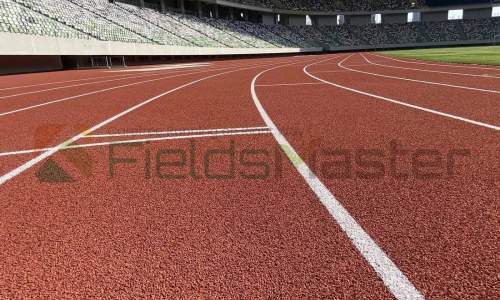
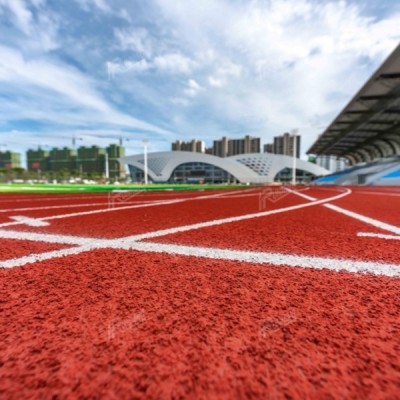
The track itself, meanwhile, is not just a red or blue loop around a sports field. For schools, public parks, clubs and community stadiums, it is a long-term infrastructure decision that affects athlete safety, lane durability, color stability, maintenance cost and the credibility of the whole sports facility.
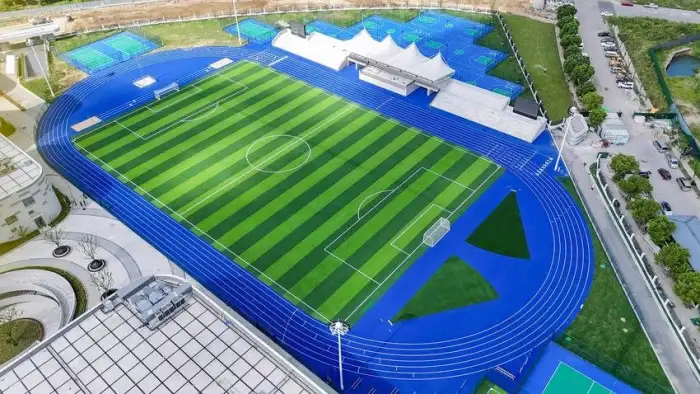
For project owners procuring an EPDM running track surface, the most important material decision is the exposed EPDM granule wear layer, because that is the part that receives sunlight, spikes, running traffic, cleaning and weather exposure every day.
If the granules fade, harden or separate from the binder, the track will look old long before the project owner expected it to.
This guide is written from FieldsMaster's material-side experience supporting contractors, distributors and project owners in outdoor track projects. FieldsMaster manufactures and supplies EPDM granules and PU binder rather than selling lump-sum construction services, so this article focuses on what buyers need to specify: granule grade, binder ratio, layer build-up, material consumption and quotation logic.
Below you will find how an EPDM track is built, why EPDM track granules are preferred over SBR and TPV for outdoor color surfaces, how to estimate material quantity for a 400 meter track, what details are often missed in long jump and field-event areas, and what to write into tender documents before you place the order.
Key Takeaways
- The wear layer is the material decision. On an outdoor track, the exposed EPDM granule layer carries the UV, spike and traffic load, so its grade drives appearance and service life more than any other single choice.
- Granules and binder are bought together. EPDM track granules, PU binder for the elastic base and the binder ratio for the top layer belong in one specification, not in separate sections of a tender document.
- A 13 mm EPDM wear layer over a PU-bound base is a common outdoor specification for school, park and club-level tracks. The final thickness should be confirmed against project grade, local standard and use intensity.
- A 400 meter track is not quoted by running distance. Lanes, D-zones, run-off areas and field-event approaches all add surface area and material.
- Material shortfalls come from omitted areas, not from the granule price. D-zones, long jump approach runs, installation loss, binder consumption and spare granules are the items most often left out.
- Color performance must be verified, not assumed. Confirm it against the test reference for the selected granule formulation and the standard applicable in the project location.
1. Why EPDM Track Granules Beat SBR and TPV for Outdoor Tracks
A running track is an exposed surface. The top layer must resist UV, abrasion, temperature changes, rainwater, cleaning and repeated foot traffic, which is why the choice of rubber granules matters more than many buyers expect.
EPDM granules are commonly used for the colored wear layer of outdoor running tracks because they offer stable color, elastic surface texture and better weather aging performance than many lower-cost alternatives. SBR and TPV can be useful in specific situations, but they do not solve the same procurement problem.
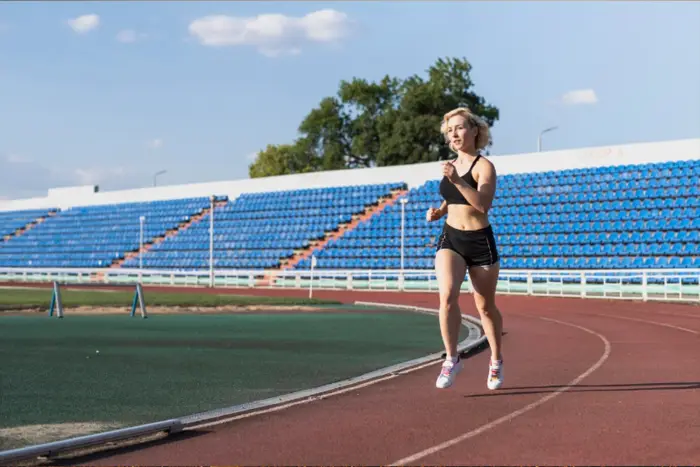
Track granule selection is usually decided by two questions rather than one: how the color holds up outdoors, and how the surface behaves underfoot in the zones that get the most traffic.
Both are material questions, which is why they are worth settling before the layer build-up is fixed.
1.1 EPDM vs SBR for running track surfaces
SBR granules are widely used in the base layer or underlayer because they are cost-effective and provide shock absorption. However, SBR is usually black and less suitable as the exposed colored wear layer for a long-term outdoor track.
When SBR is used as a visible colored layer, or when low-grade colored rubber is selected only for price, the common risks are:
- Faster color fading under sunlight
- Lower visual consistency across the track
- More obvious aging in high-traffic zones
- Shorter perceived project life, even if the base remains usable
EPDM granules are better suited to the exposed top layer because they are designed for color, UV stability and outdoor surface performance. The full material comparison is set out in the article on EPDM versus SBR.
1.2 EPDM vs TPV for outdoor track projects
TPV granules can offer certain elastic and weathering advantages, but in many B2B track projects the buyer must also weigh local installation familiarity, color availability, project budget, binder compatibility, material lead time and replacement convenience.
For school, park and club-level outdoor tracks, EPDM remains a practical and widely adopted option because it balances color stability, surface performance and procurement availability. The background is covered in why EPDM granules dominate sports surfaces.
1.3 Color durability is not a sample-tray decision
A new granule sample can look good in the office, but a running track is judged after several summers outdoors. Color performance should therefore be confirmed from documentation rather than from appearance alone: ask for the UV aging or color fastness test reference that applies to the selected granule formulation, together with batch consistency information, before approving the material.
Actual performance depends on the pigment system, granule formulation, PU binder ratio, installation quality, drainage and local climate. Where a project sets its own color stability target, that target should be verified against the standard applicable in the project location. The technical background is in UV resistance and wear performance in EPDM granules.
2. EPDM Running Track Surface Build-Up: Base, Binder and Wear Layer
A reliable EPDM rubber running track starts below the visible red, green or blue surface. The system should be planned as a complete build-up, not as a price for colored granules.
A common outdoor EPDM running track build-up includes:
- Compacted sub-base or crushed stone layer: provides structural stability and drainage support.
- Asphalt or concrete leveling layer: creates a flat and stable platform for the rubber system.
- PU primer and base treatment: improves adhesion between the prepared base and the rubber layer.
- PU-bound elastic base layer: often made with SBR granules and PU binder for shock absorption and leveling.
- 13 mm EPDM granule wear layer: the exposed top layer that provides color, grip, UV resistance and track appearance.
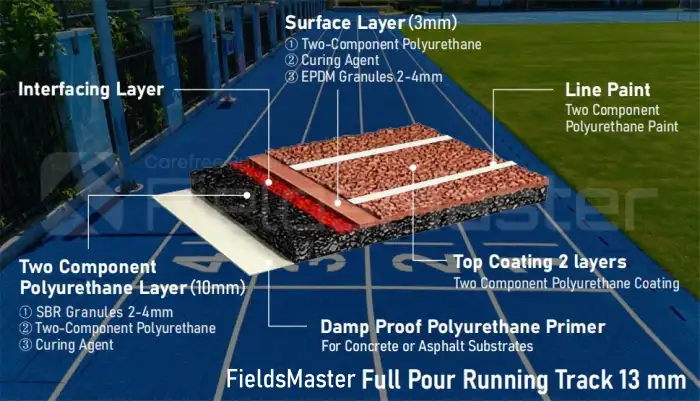
The exact specification depends on project grade, budget, local standard, climate and intended users. A school training track and a competition venue should not be treated as the same specification.
For the material side of the system, see the EPDM granule range for sports tracks and the PU binder range.
2.1 Why the 13 mm EPDM wear layer matters
A 13 mm EPDM wear layer is commonly used for outdoor school, park and club-level tracks because it gives the surface enough depth for color, texture, wear resistance and long-term maintenance. Reducing the top layer only to lower upfront cost may create problems later, especially in lane one, starting areas and training zones where foot traffic is concentrated.
For buyers, the question should not be how cheap the EPDM granule is. The better question is whether the build-up provides the right surface thickness, binder ratio and material quantity for the expected use intensity. Temperature and resilience behavior is covered in EPDM track granule standards.
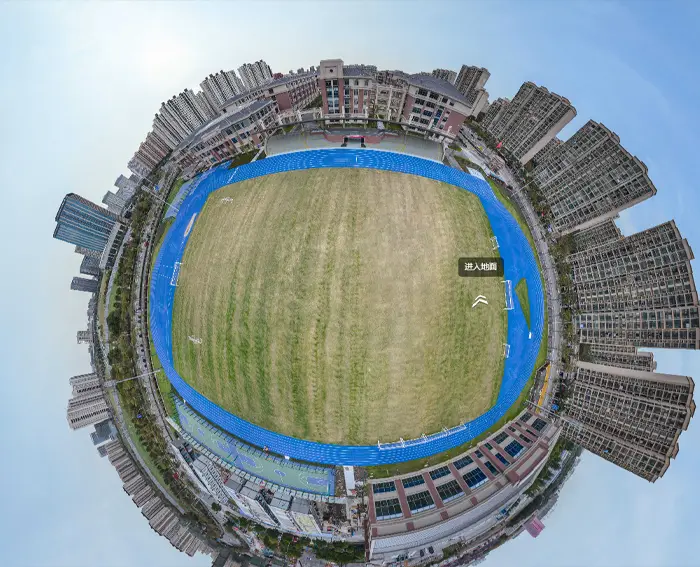
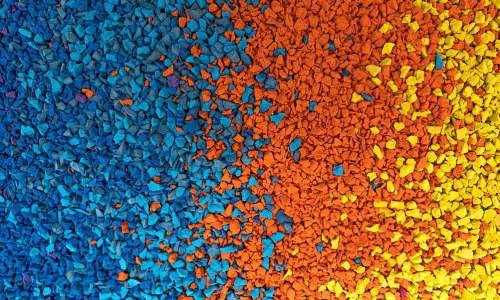
The wear layer is supplied as colored granule in a defined particle size range, which is where the surface texture and the visual grain of the finished track are decided.
Particle size selection is covered in the guide to choosing EPDM granule size and in the article on particle size, mesh size and distribution.
2.2 Material calculation for a 400 meter running track
A standard 400 meter track is not quoted by running distance. Buyers need the actual surface area, including lane width, number of lanes, D-zones, run-off areas and field-event approaches.
A practical estimation process is:
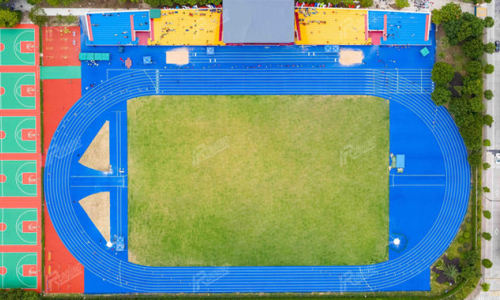
- Confirm the track layout: number of lanes, lane width, straights, curves and D-zone areas.
- Calculate total surfacing area in square meters.
- Confirm the base layer thickness and EPDM top layer thickness.
- Calculate EPDM granule consumption according to thickness, density and installation loss.
- Calculate PU binder consumption according to the recommended binder ratio for each layer.
- Add spare material for repair, color matching and on-site adjustment.
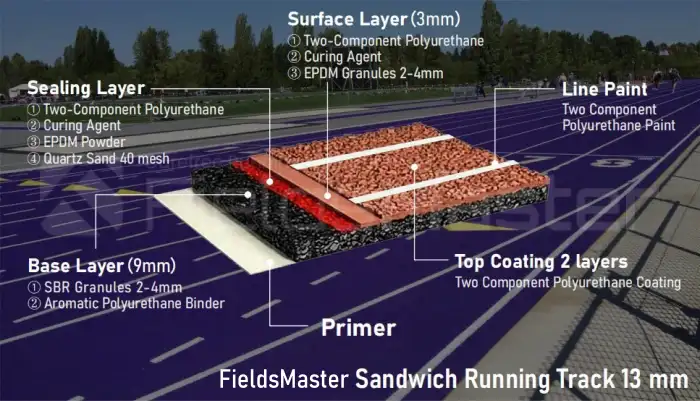
Different track systems place the granule layer differently, and that changes which materials are bought in which quantity. A sandwich structure and a full pour structure do not consume the same granule and binder volumes for the same area.
See the running track surfacing solutions overview for the systems, and the material calculator for a first-pass estimate.
2.3 Common material estimation errors
For project owners, the biggest cost surprises usually come from missing areas or oversimplified assumptions rather than from unit prices. The recurring errors are:
- Calculating only the oval track and forgetting D-zones
- Ignoring long jump track and approach run areas
- Using one thickness for all areas despite different traffic intensity
- Forgetting installation loss and spare material
- Underestimating PU binder consumption
- Not separating base layer materials from EPDM top layer materials
- Treating lane markings, edge details and drainage repair as if they were included in the granule price
FieldsMaster recommends calculating the material list from actual drawings or confirmed measurements rather than relying on a generic 400 meter track price.
3. EPDM Track vs Synthetic Athletics Track: Which Specification Fits
The phrase synthetic athletics track can refer to several systems. Some projects use EPDM granule surfaces, some use hybrid systems, and professional venues may require full PU or higher-grade systems depending on performance requirements.
For procurement, the right question is not which system sounds more advanced. It is which specification fits the project level, budget, maintenance capacity and expected users.
| Track system | Typical cost position | Expected lifespan | Maintenance | Suitable project level |
|---|---|---|---|---|
| EPDM running track | Medium | 8-10 years with proper material and installation | Moderate; localized repairs possible | Schools, parks, clubs, community sports facilities |
| Hybrid running track | Medium to high | 8-10 years depending on system quality | Moderate; requires system-specific repair method | Training venues and higher-use public tracks |
| Full PU athletics track | High | 8-10+ years depending on grade and maintenance | Higher technical maintenance requirement | Professional stadiums and performance-oriented venues |
An EPDM track is often the best fit when the project needs durable color, safe training use and a manageable budget. A full PU track may be justified when the venue has strict athletic performance requirements, higher funding and experienced maintenance support.

Whichever system is chosen, the visible result still comes back to the granule layer, because that is the part the user sees and the part that ages first.
The broader comparison across surfacing materials is in the complete guide to EPDM running tracks and in how to choose running track flooring.
3.1 Rubber granules track and field: options for higher standards
For track and field projects, buyers often ask whether a rubber granules system can be compatible with professional expectations. The answer depends on the required project level and the local standard the project must meet.
For school, park and club-level projects, an EPDM granule top layer over a PU-bound elastic base can provide a practical, safe and visually durable solution. For higher-level athletics venues, the specification should be checked against the relevant sports authority requirements, including thickness, force reduction, vertical deformation, friction, spike resistance, drainage and line marking rules.
FieldsMaster can support material-side planning for rubber granules track and field projects by helping buyers define EPDM granule particle size and color, base layer and top layer thickness, PU binder ratio for each layer, estimated consumption per square meter, packaging plan and spare material quantity, and the material documentation required for tender support.
Where formal certification is required, the final system must be verified through the project owner, contractor, testing body and the applicable local standard.
4. Long Jump Track and Approach Run Details Buyers Forget
Many running track quotations focus on the main oval and then treat field-event areas as small extras. That is risky. A long jump track and approach run receive repeated sprinting, braking and take-off stress in a narrow traffic line, so the surface specification should not be treated as decorative flooring.
4.1 Long jump approach run requirements
A long jump approach run should provide stable grip, consistent rebound and reliable bonding in the take-off zone. Compared with general walkway areas, it needs stronger attention to:
- Surface flatness and drainage
- Wear resistance in the final take-off section
- Correct top layer thickness
- Binder strength under repeated sprinting stress
- Edge finishing near the sand pit
- Color consistency if the approach run is connected visually to the main track
4.2 Field-event areas need separate material planning
Besides long jump, many track projects include high jump, pole vault, javelin run-up, shot put surroundings or multi-use D-zones. These areas may have different impact, spike, braking and maintenance requirements.
If the quotation only includes the 400 meter oval, the project owner may later discover that field-event areas require additional EPDM granules, PU binder, edge work, drainage treatment or repair allowance.
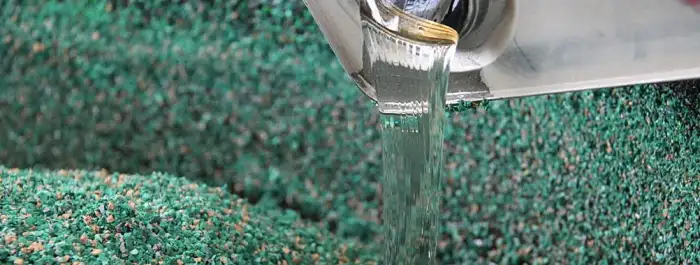
Field-event areas consume the same two materials as the oval, so leaving them out of the list is a quantity error rather than a separate purchase.
The binder side of that pairing is covered in the PU binder tensile test comparison and in mixing EPDM granules with binder.
4.3 Tender documents should specify these 8 EPDM running track parameters
To make supplier quotations comparable, project owners should write the following parameters clearly into the tender or RFQ document:
- Total track area, including lanes, D-zones and field-event approach areas.
- Number of lanes and lane width.
- Base layer or underlayer thickness and material type.
- EPDM top layer thickness, commonly 13 mm for many outdoor track projects.
- EPDM granule particle size range and color plan.
- Recommended PU binder ratio for base layer and top layer.
- Required safety, UV aging, color fastness or heavy metal test references.
- Packaging quantity, installation loss allowance and spare material requirement.
These eight points prevent the common situation where two suppliers quote the same project but one includes only granules while the other includes binder, loss and spare material, so the two numbers cannot actually be compared.
5. How FieldsMaster Supports EPDM Running Track Projects
FieldsMaster supplies EPDM granules and PU binder for running tracks, sports courts, playgrounds and outdoor recreation surfaces. For running track projects, the role is to help buyers define the material package behind the surface: granule grade, color, particle size, binder ratio, consumption and packaging.
For a typical EPDM granules track inquiry, FieldsMaster can help review:
- Track application: school, park, club, training venue or public sports facility
- Surface area and layout: oval, lanes, D-zones and field-event areas
- Base layer and EPDM top layer thickness
- Color plan and batch consistency requirement
- PU binder type and consumption estimate
- Packaging plan for shipping and on-site handling
- Spare material quantity for future repair and color matching
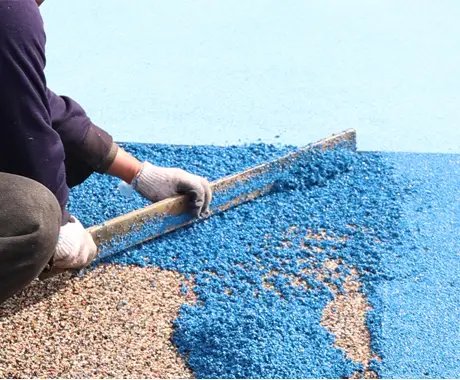
Technical review: FieldsMaster Sports Surfacing Team, working on EPDM granule formulations, PU binder systems and outdoor rubber sports surface material calculation for contractors, distributors and project owners.
Material documentation, samples and the standard color range are available through the free sample request, the regular color card and the manufacturing overview.
5.1 Talk to FieldsMaster about your running track project
If you are planning an EPDM running track, the fastest way to avoid material errors is to calculate from the actual layout instead of asking for a generic price per square meter. Before requesting a quotation, prepare the track length and width, the number of lanes and lane width, the total surface area if available, the base layer and EPDM top layer thickness, the long jump and D-zone details, site photos or a layout drawing, the required color plan, and whether you need EPDM granules only, PU binder, or a full material package.
FieldsMaster will convert these details into a running track surfacing material list, including EPDM granules, PU binder, estimated loss, packaging quantity and spare material recommendation. Submissions can be made through the project quotation page, and the full EPDM granules and EPDM granules for sports ranges show what is supplied. If the project also covers other outdoor areas, the EPDM sports surface solutions guide covers courts, playgrounds and fitness zones.
6. FAQ
How thick should an EPDM running track be?
For many school, park and club-level outdoor running tracks, a 13 mm EPDM wear layer over a PU-bound base is a common specification. The final thickness should be confirmed according to project grade, local standard, base condition, safety requirement and expected use intensity.
Can EPDM granules be used on outdoor athletics tracks?
Yes. EPDM granules are commonly used as the colored wear layer on outdoor tracks because they provide UV-stable color, anti-slip texture, elastic surface feel and weather resistance. For higher-level athletics venues, the final system should be checked against the applicable sports authority or testing standard.
How long does an EPDM running track last?
A well-installed EPDM running track can typically last 8-10 years with proper base preparation, correct PU binder ratio, drainage and routine maintenance. Lifespan depends on traffic intensity, climate, UV exposure, installation quality and the grade of EPDM granules used in the top layer.
What is the difference between an EPDM running track and an SBR track?
SBR is usually used in the base layer because it is cost-effective and provides shock absorption. EPDM is preferred for the exposed colored top layer because it offers better UV resistance, color stability and outdoor aging performance.
What information is needed for a running track quotation?
A useful quotation should be based on track area, lane number, lane width, base layer thickness, EPDM top layer thickness, color plan, field-event areas, PU binder ratio, installation loss and packaging requirement. Site photos or a layout drawing help FieldsMaster calculate the material list more accurately.
Before you compare two track quotations, check what is missing from both. Running track material shortfalls almost never come from the granule price. They come from five things that are quietly left out of one supplier's list and included in the other's:
- PU binder — a quantity calculated from the selected granule, each layer and the agreed binder ratio, not a rounded allowance.
- D-zone area — the inside areas of the oval are surface too, and they are frequently missing from the measured area.
- Long jump approach runs and field events — narrow, high-stress zones that consume the same granule and binder as the main track.
- Installation loss — a stated figure for the project, which moves with particle size range, substrate, thickness, weather and installer technique.
- Spare granules for repair and color matching — the only way to keep a repaired lane visually consistent with the rest of the track later.
Any one of them missing surfaces mid-installation, when reordering is slowest and most expensive and the crew is already on site. Send FieldsMaster your track layout, target surface thickness and site photos through the project quotation page, and the material list comes back with granule, binder, loss, packaging and spare material accounted for within 48 hours.