

EPDM Granules for Running Track Surfacing: Materials, Selection and Supply Guide 2026
When project owners talk about an EPDM running track, they usually care about the finished surface: color, grip, rebound and how the track will look after years outdoors. In procurement, those results come back to the material package behind the surface: EPDM granules for the exposed wear layer, PU binder for the elastic base and top layer, and spare material for future color-matched repairs.
For EPC contractors, distributors and project owners, the right EPDM granules can make the difference in color stability, surface texture and long-term appearance.
Quick answer: The material side of an outdoor running track comes down to two products: EPDM granules for the wear layer and PU binder for the bound layers. What a buyer can fix in advance is the granule specification — particle size range, distribution, colour reference, the UV aging or colour fastness reference requested for the formulation, hardness band and packaging — together with the binder ratio agreed for each layer. The layer build-up and the structure are system decisions, and they are set out in the project owner guide. A comparison is only valid when both quotations list the same items against the same measured area.

This guide is written from FieldsMaster's material-side experience as a supplier of EPDM granules and PU binder for sports surfacing projects. FieldsMaster does not position itself as a lump-sum running track contractor.
Instead, the focus is on helping buyers specify the material package behind the surface: granule grade, particle size, color, binder ratio, layer thickness, material consumption, packaging and quotation logic.
For buyers comparing EPDM granules suppliers, unit price is only one part of the decision. A more useful question is whether the supplier can help estimate the complete track material package before the order is placed.
Key Takeaways
- Two products are being bought. EPDM granules for the wear layer and PU binder for the bound layers, quoted as separate lines.
- The granule specification is only comparable when it is written out. Particle size range, distribution, colour reference, the UV aging reference requested for the formulation, hardness band and packaging plan.
- Colour is a supply-planning question. Whether one production batch can cover the whole track is decided before the order is placed, not after delivery.
- Binder quantity is a calculation, not a percentage. It follows the granule selected, the layer it goes into and the agreed ratio, and installation loss belongs on its own line.
- Quotations differ mostly in what is missing. PU binder, D-zone area, field-event areas, installation loss and spare granules are the usual gaps.
- Supplier comparison is a documentation exercise. Colour samples, particle size range, UV aging references, batch consistency control and a project-based material calculation.
1. Why EPDM Track Granules Beat SBR and TPV for Outdoor Tracks
A running track is an exposed outdoor surface. The top layer deals with sunlight, abrasion, temperature changes, rainwater, cleaning and repeated traffic every day, which is why EPDM granules matter more than many buyers expect.
SBR granules are cost-effective and widely used in the base layer or underlayer because they provide shock absorption. However, SBR is usually black and is not the preferred material for a long-term exposed colored track surface. When low-grade colored rubber is selected only because it is cheap, project owners may face faster fading, uneven aging and higher repair risk.
TPV granules can offer certain elastic and weathering advantages, but many B2B projects also need to consider installation familiarity, color availability, binder compatibility, lead time, budget and local contractor experience. For school, park and club-level outdoor tracks, EPDM remains a practical and widely adopted material choice.
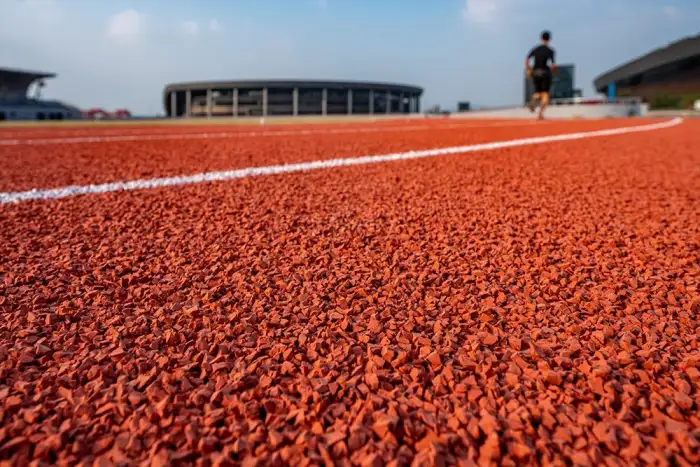
A sample tray is useful, but it does not tell the full story of outdoor color durability. A sample may look attractive before installation, while the real test comes after several summers of UV exposure.
When comparing EPDM granules suppliers, buyers can ask for UV aging references, color fastness information and batch consistency control before confirming the order. See EPDM versus SBR and why EPDM granules dominate sports surfaces.
Marathon-season traffic and school sports days put the same granule layer under very different loads, so it is worth reviewing the EPDM granule range for sports tracks and the EPDM granules product overview alongside the color plan.
2. Specifying EPDM Granules and the PU Binder That Goes With Them
What a track buyer purchases on the material side is two products: EPDM granules for the wear layer, and PU binder for the bound layers. Most quotation disputes trace back to how those two were specified, not to the surface design.
The layer build-up itself is a system decision and is described separately in the track surface build-up section of the project owner guide. The rest of this section covers the material side: what belongs in a granule specification, and how a binder quantity is derived.
2.1 What to write into an EPDM granule specification
| Item | What to state | Why it changes the quotation |
|---|---|---|
| Particle size range | The range ordered, for example 1-3 mm, 2-4 mm or 3-6 mm, plus the acceptable distribution | Two quotations are often not for the same product, because suppliers quote different ranges |
| Colour and batch | A colour reference for each area, and whether one production batch can cover the whole track | Decides whether the order ships as one lot or has to be split across lots |
| Pigment and UV system | The formulation the granule is supplied with, plus the UV aging or colour fastness reference requested for it | Buyers compare this reference between suppliers; the finished surface still depends on the full system, the base, the thickness and the installation |
| Hardness and purity | The hardness band the supplier controls, and the purity the granule is supplied at | Ask for the controlled band rather than a single figure, so the delivery can be checked on arrival |
| Packaging | Bag weight, pallet configuration, and how the order reconciles to consumption on site | Sets the number of handling units the site has to store, open and account for |
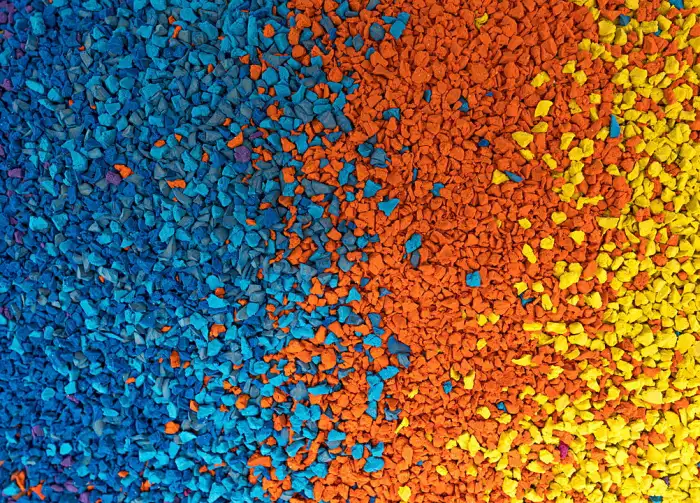
Colour is specified per area of the track, and the practical question behind it is whether the whole order can be covered from one production batch.
The published range is set out on the regular color card.
2.2 How a PU binder quantity is derived
Binder is not a rounded percentage added at the end of a quotation. The quantity follows three things that have to be settled first: the granule selected, the layer the binder goes into, and the binder ratio agreed for that layer.
- Agreed per layer, not per project. A base layer and a wear layer do not share one figure, and the quotation should say which layer each quantity belongs to.
- Shown as a calculation, not as an allowance. Ask for the binder quantity to be stated against the same measured area as the granule quantity, so the two can be checked against each other.
- Loss kept as its own line. Consumption on site also moves with substrate condition, layer thickness, weather and installer technique, so it belongs in a separate figure instead of being folded into the ratio.
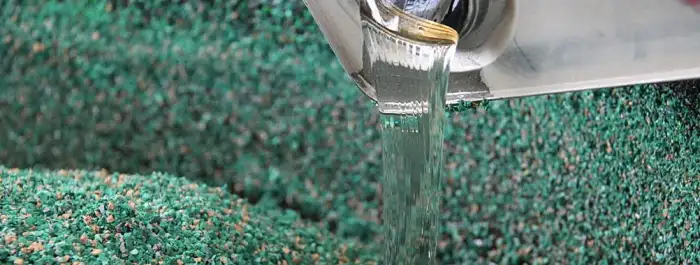
When one supplier provides both lines, the granule specification, the binder ratio and the packaging plan can be reviewed as a single material list.
Binder behaviour under load is compared in the PU binder tensile test comparison, and the supplied range is on the PU binder page.
Two quotations for the same track often differ because one prices granules only, while the other carries binder, loss and spare material as separate lines. Comparing them line by line shows the difference faster than comparing a total.
3. Choosing a Granule Specification for the Project Level
Granule grade is one of the few material decisions a buyer can settle before the system is fixed, and the project level changes what belongs in that specification rather than which brand is quoted.
| Project level | What to fix in the granule specification | What the quotation should show separately |
|---|---|---|
| School, park and community track | A published outdoor colour range, an agreed particle size range and a stated distribution | Granules, PU binder, installation loss and spare material as four lines |
| Training venue or high-use public track | The same, plus a batch plan showing whether the whole area comes from one production lot | The same four lines, with the batch plan attached to the order |
| Competition-oriented venue | The UV aging or colour fastness reference requested for the selected formulation, so the project standard can be checked against it | The same four lines, plus the material references the project standard asks for |
Whichever level applies, the same two materials are being bought. A quotation becomes comparable only when both sides write the granule specification out in the same terms.

Whichever system is chosen, the visible result still comes back to the granule layer, because that is the part the user sees and the part that ages first.
The wider comparison is covered in the EPDM running tracks complete guide, in the running track structures and project owner guide, and in the EPDM sports surface solutions guide.
3.1 Rubber granules track and field: World Athletics-aware options for higher standards
For track and field projects, buyers often ask whether a rubber granules system can be compatible with higher-level performance expectations. The answer depends on the project level and the local standard.
Even where a project references World Athletics-style performance requirements, the material side can be quoted precisely: the granule specification, the binder ratio and the declared references travel with the order. The system-level compliance decision stays with the contractor, the testing body and the project owner, checked against the applicable local standard before tender submission.
4. Why Project Owners Work with FieldsMaster for EPDM Granules
For a running track project, the supplier behind the material matters as much as the quoted granule price. FieldsMaster's published manufacturing profile lists 30+ years of industry experience, 4 self-invested automated EPDM granules factories, 600,000 tons of annual output, a 60,000 m² production base, 10 rubber internal mixers, 23 testing instruments and equipment, and supply coverage across 50+ countries and regions. These figures give project owners a more concrete view of the production infrastructure behind the material package.
4.1 What FieldsMaster brings to a running track material package
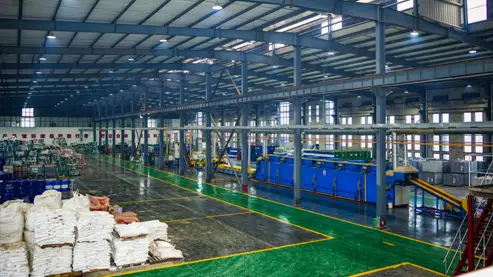
Production capacity answers a different procurement question from price: whether the material can actually be supplied in the volume, color and particle range a track programme needs, in the season it is needed.
The published figures behind that question are set out on the manufacturing capability page.
- Integrated EPDM granules and PU binder supply: FieldsMaster supplies both materials for the visible wear layer and the PU-bound base discussion, so particle size, binder compatibility and estimated consumption can be reviewed together rather than sourced as unrelated line items.
- Production controls that show up in the finished surface: incoming raw-material batch testing, computer-controlled auxiliary material dosing, screening through specific mesh sizes, dust removal and automated weight-controlled packaging. For buyers, these are the steps connected with more repeatable particle size, color and bag weight.
- A visible color system, not an unnamed shade list: FieldsMaster publishes product color cards across the Chameleon, Jaguar and Eagle series. The Eagle series is presented for high-UV areas, giving buyers a clear starting point when color durability is a key concern.
- Track quotation support built around actual project inputs: instead of starting only from a price per kilogram, FieldsMaster can organize a material estimate around track area, base layer thickness, EPDM top layer thickness, color plan, D-zones, long jump approach runs, expected installation loss and spare granules.
- A procurement path for different roles: project owners, EPC contractors and distributors can start from the same material data, then discuss the documentation, packaging and quotation format that suits their procurement role.
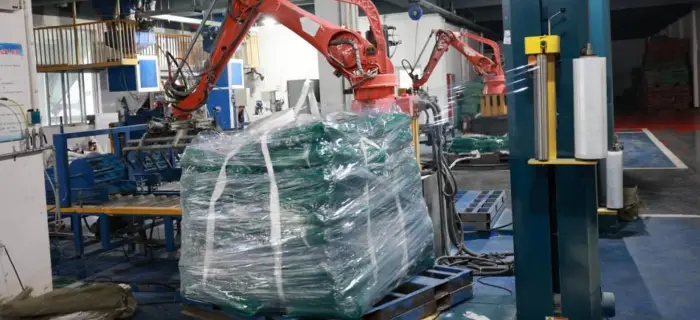
Packaging and palletizing are part of the material offer, not an afterthought, because bag weight and handling affect site logistics and spare-material planning.
Buyers can review the EPDM material calculator, the regular color card, the free sample request, the project quotation page and the manufacturing capability page before moving into a detailed discussion.
The value is not simply a longer material list. It is a more traceable path from color selection and granule specification to production capability, calculation inputs, packaging and project quotation. The final system design and installation method are still coordinated with the contractor and relevant project professionals.
5. Talk to FieldsMaster About Your Running Track Project
FieldsMaster supplies EPDM granules and PU binder for running tracks, sports courts, playgrounds and outdoor recreation surfaces. For running track projects, the role is to help buyers define the material package behind the surface: granule grade, color, particle size, binder ratio, consumption and packaging.
Technical review: FieldsMaster Sports Surfacing Team, working on EPDM granule formulations, PU binder systems and outdoor rubber sports surface material calculation for contractors, distributors and project owners.
Before requesting a quote, prepare:
- Track layout or site photos
- Number of lanes and lane width
- Total surface area if available
- Base layer thickness and EPDM top layer thickness
- Long jump track, D-zone or field-event area details
- Required color plan
- Whether you need EPDM granules only, PU binder, or a full material package
If the project also covers other outdoor areas, the EPDM surfacing solutions for sports and outdoor projects page covers courts, playgrounds and fitness zones, and the EPDM granules for sports range shows what is supplied for track work.
6. FAQ
What particle size should I order for a running track?
Particle size is agreed as part of the granule specification and should be written into the order together with the acceptable distribution. The range that suits a project follows from the full system, the layer the granule goes into, the agreed thickness and the appearance the owner wants, so it is normally fixed together with the contractor or the system supplier rather than picked from a price list.
How is the PU binder quantity for a running track calculated?
From the granule selected, the layer the binder goes into and the binder ratio agreed for that layer. A quotation should show the binder quantity against the same measured area as the granule quantity, with installation loss kept as a separate line, because consumption on site also moves with substrate condition, layer thickness, weather and installer technique.
Can EPDM granules be used on outdoor athletics tracks?
Yes. EPDM granules are commonly used as the colored wear layer on outdoor tracks because they provide UV-stable color, anti-slip texture, elastic surface feel and weather resistance. For higher-level athletics venues, the final system is usually reviewed against the applicable sports authority or testing standard.
How can buyers compare EPDM granules suppliers for running tracks?
A practical comparison can include EPDM granule particle size, color samples, UV aging references, batch consistency, PU binder recommendation, packaging, spare material support and project-based material calculation. A lower granule price is not always a lower project cost if binder, D-zones, long jump areas or installation loss are missing from the quote.
A granule price is only comparable when the same lines are priced against the same area. Four items decide whether two EPDM granule quotations can be compared at all, and they are the ones most often left out of the shorter list:
- PU binder — stated per layer against the ratio agreed for that layer, rather than added as a rounded allowance at the end.
- Measured area — the oval, the D-zones and the field-event approaches all consume granules, and they are not always inside the figure the supplier quoted against.
- Installation loss — a figure for this project instead of an assumed percentage, because it moves with the substrate, the layer thickness, the weather and the installer.
- Spare granules — enough to repair a lane later without a colour mismatch against the rest of the track.
A line missing here is normally found on site rather than in the quotation, at the point where a reorder can no longer arrive in time.
Want the granule and binder quantities checked before you confirm the order? Send FieldsMaster three numbers — total square meters, base layer thickness and EPDM granule top layer thickness — through the project quotation page, and the material list comes back with granules, PU binder, installation loss, packaging quantity and spare material accounted for within 48 hours.