

How to Master EPDM Supplier Selection: Key Criteria for Choosing a Quality Granules Manufacturer and Distributor Partner
I know firsthand the challenge of ensuring a project's success hinges on critical material choices. When it comes to EPDM wet pour systems, the foundation of safety, durability, and vibrant aesthetics lies squarely with the quality of the EPDM granules. Selecting the right EPDM supplier isn't just about finding a provider; it's about securing a reliable granules manufacturer and distributor partner who aligns with our commitment to excellence. This can often feel overwhelming, given the many options in the market.
In this guide, I will share my insights into mastering EPDM supplier selection, focusing on the key criteria we use to identify partners who deliver superior products and unwavering support for our projects.
Why Our EPDM Supplier Selection Journey for a Granules Manufacturer Begins with Understanding Quality
The first step in any successful procurement process is a deep, foundational understanding of the material itself. For EPDM (Ethylene Propylene Diene Monomer) granules, this means looking beyond the price tag to appreciate the science and engineering that deliver safety, longevity, and visual appeal. A high-quality granule is the DNA of a successful wet pour surface, dictating its performance for years to come.
The Global Benchmark: What We Expect from EPDM Wet Pour Systems
When we specify EPDM wet pour systems for playgrounds, athletic tracks, or recreational areas, we are adhering to a global standard of excellence. This standard is not arbitrary; it's built on a clear set of expectations that prioritize user well-being and long-term value.
Safety and Durability: Non-Negotiable Standards
At its core, an EPDM wet pour surface is a safety system. Its primary function, especially in a playground setting, is to absorb impact and reduce the severity of injuries from falls. This is quantified by the Critical Fall Height (CFH), a measure of the height from which a fall onto the surface is not expected to cause a life-threatening head injury. A quality EPDM system, properly installed with a shock-absorbent base layer of SBR (Styrene-Butadiene Rubber), must meet stringent international safety standards like ASTM F1292 in the United States and EN 1177 in Europe.
Durability is the other side of the safety coin; a surface that degrades cannot be considered safe. We expect EPDM granules to exhibit high tensile strength and elongation at break, allowing the surface to withstand constant foot traffic, play equipment, and thermal expansion without cracking or breaking. It must also be resistant to weathering, UV radiation, and temperature extremes, ensuring it remains a safe, integral surface for its entire projected lifespan, which can exceed 15 years with proper installation and maintenance.
| Safety & Durability Feature | Key Performance Indicator (KPI) | Relevant Standard (Example) |
|---|---|---|
| Impact Absorption | Critical Fall Height (CFH) rating | ASTM F1292 / EN 1177 |
| Slip Resistance | Coefficient of Friction (even when wet) | BS 7188 |
| Tensile Strength | Resistance to tearing (measured in MPa) | BS EN ISO 37 |
| Elongation at Break | Flexibility before breaking (as a %) | BS EN ISO 37 |
| UV Resistance | Color retention after accelerated weathering | Xenon Arc Test (e.g., ISO 4892-2) |
Vibrant Aesthetics: Color Stability and Customization
Beyond safety, EPDM surfaces are chosen for their tremendous design flexibility. The ability to create intricate patterns, logos, and colorful zones is a key advantage. This aesthetic value, however, is entirely dependent on the quality of the granule's color. A premier granules manufacturer provides a wide spectrum of vibrant, consistent colors.
We expect two things in this regard:
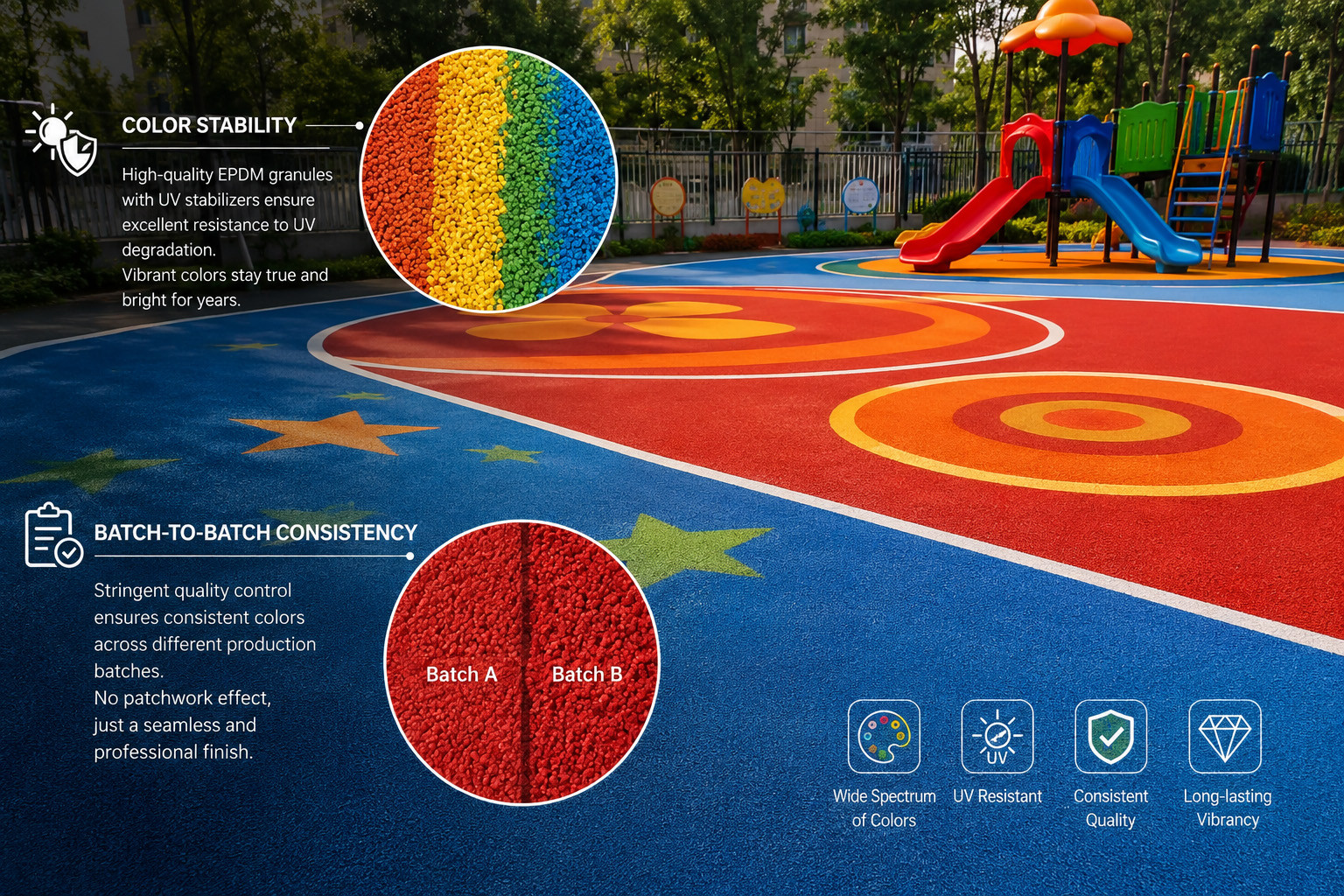
- Color Stability: The granules must be highly resistant to UV degradation. There is nothing worse than a brightly colored design that fades into a pastel blur after just a few years of sun exposure. High-quality EPDM granules have UV stabilizers integrated into their composition to ensure colors remain true and vibrant for years.
- Batch-to-Batch Consistency: For large projects, multiple batches of granules are often required. A reliable supplier must have stringent quality control to ensure that "flag red" from batch A is identical to "flag red" from batch B. This prevents a patchwork effect and ensures a seamless, professional finish.
The Critical Role of EPDM Granule Quality in Our Projects
Using substandard granules is a short-term saving that leads to long-term failure and significant financial consequences. The quality of the raw material is the single most important factor in the success and longevity of a poured-in-place rubber surface.
Preventing Common Pitfalls: Fading, Cracking, and Failed Inspections
Low-quality EPDM granules introduce a host of preventable problems:
- Premature Fading: Granules with poor UV stability will quickly lose their color, diminishing the aesthetic appeal of the project and making the space look old and worn before its time.
- Hardening and Cracking: Inferior EPDM may have an improper polymer or plasticizer content, causing it to harden and become brittle over time. This leads to surface cracking, which creates trip hazards and allows water ingress, accelerating the degradation of the entire system.
- Granule Loss (Raveling): Poor tensile strength or an incompatible binder can cause the granules to dislodge from the surface under normal foot traffic. This not only creates an unsightly appearance but also reduces the surface's thickness, potentially compromising its CFH safety rating.
- Failed Inspections: Ultimately, a surface that fails to meet safety standards like ASTM F1292 is not fit for purpose. A failed inspection can lead to costly remediation or a complete tear-out and replacement, turning a "cost-saving" material choice into a catastrophic financial loss.
Understanding Material Composition: Virgin vs. Recycled Content
When specifying EPDM, it's crucial to understand the material's origin. The two main categories are virgin EPDM and recycled EPDM.
- Virgin EPDM Granules: These are produced from new, first-generation Ethylene Propylene Diene Monomer polymer. This process allows for precise control over the chemical composition, leading to superior performance. Virgin granules typically offer the best elasticity, highest UV resistance, and most consistent and vibrant colors. For high-performance athletic tracks and premium architectural projects where color fidelity and longevity are paramount, virgin EPDM is the preferred choice.
- Recycled Content: This can be a bit of a gray area. Some products are marketed as EPDM but may contain fillers or a blend of different post-consumer rubber materials. While using recycled materials can be an admirable environmental goal, it's critical to know what is being recycled. For example, the SBR rubber used in the base layer of a wet pour system is typically made from recycled truck tires. However, for the top "wearing" layer, using an unknown recycled blend can compromise color consistency, UV stability, and overall performance. When considering any material with recycled content, we demand full transparency from the supplier regarding its source, composition, and performance data.
For our projects, we prioritize virgin EPDM for the top layer to guarantee performance, safety, and aesthetics, while leveraging high-quality recycled SBR for the cushioning base layer. This hybrid approach, which you can explore on our products page, provides the best balance of performance, safety, and value.
Our Proven Criteria for Strategic EPDM Supplier Selection: Finding the Right Granules Manufacturer and Distributor Partner
Choosing a supplier is a strategic decision. The right partner acts as an extension of our team, providing not just a product, but also reliability, expertise, and support. We have developed a five-point evaluation system to ensure we only partner with EPDM granules manufacturers and distributors who meet our high standards.
Criterion 1: Unwavering Product Quality and International Certifications
This is the bedrock of our selection process. A supplier's verbal assurances are meaningless without verifiable proof of quality, demonstrated through rigorous testing and adherence to global standards.
UV Resistance and Color Stability: The Core of Longevity
We require suppliers to provide quantitative data on their product's UV resistance. This often comes from accelerated weathering tests, such as those performed in a QUV or Xenon Arc test chamber, which simulate years of sun exposure in a matter of weeks. We look for a minimal change in color (measured by Delta E) after thousands of hours of exposure. A supplier who can't provide this data is immediately disqualified. Color stability is a direct indicator of high-quality polymer composition and a manufacturing process that doesn't cut corners.
Compliance with Global Standards (ISO, EN, PAH/RoHS)
Certifications are the language of trust in manufacturing. We require a potential partner to provide a comprehensive technical data sheet (TDS) and safety data sheet (SDS) for their granules. Furthermore, we look for proof of compliance with key international standards:
- ISO 9001: This demonstrates a commitment to a consistent quality management system, from raw material sourcing to final product inspection.
- EN 1177 & ASTM F1292: While the final installed system is tested for this, the granule's properties are a crucial component. The supplier should understand these standards and provide granules that are proven to work in certified systems.
- PAH/RoHS MCompliancen: This is a critical health and safety checkpoint. EPDM granules, especially for playgrounds, must be free from harmful Polycyclic Aromatic Hydrocarbons (PAHs) and comply with the Restriction of Hazardous Substances (RoHS) directive. A supplier must provide third-party lab reports verifying that their products are non-toxic and safe for children and the environment.
Criterion 2: Robust Production Capacity and Advanced Manufacturing
A supplier’s ability to produce high-quality granules is irrelevant if they cannot deliver the required quantity on time. We assess both the scale and sophistication of their manufacturing operations.
Ensuring Consistent Supply and High-Volume Needs
We evaluate a supplier's production capacity in tons per month/year. This helps us understand if they can handle our project pipeline, including large-scale or concurrent projects, without creating bottlenecks. We inquire about their typical lead times for both standard and custom colors and their inventory management strategy. A reliable partner has a buffer of popular colors in stock and a clear, predictable timeline for custom production runs.
The Role of Automation and Quality Control in Granules Production
Modern, automated manufacturing facilities are a strong indicator of a quality-focused supplier. Automation in mixing, curing, and granulation leads to higher consistency and fewer errors. We look for suppliers who utilize:
- Automated Dosing Systems: To ensure precise and repeatable mixing of polymers, pigments, and additives.
- In-line Quality Control: Using sensors and machine vision to monitor particle size distribution, color, and shape in real-time.
- Rigorous Batch Testing: Every production batch should be tested for key properties like hardness, density, tensile strength, and color, with a certificate of analysis (COA) available for each.
A tour of the factory, either virtual or in-person, can be incredibly revealing about a company's commitment to quality. The level of cleanliness, organization, and investment in modern technology speaks volumes.
Criterion 3: Comprehensive Product Portfolio and Customization Capabilities
Our projects are diverse, and we need a partner with a product range that can meet any challenge, from a simple playground to a professional-grade athletic facility.
Variety in Granule Types (Virgin EPDM, TPV, Size Options)
A premier supplier offers more than just one type of granule. We look for a portfolio that includes:
- Premium Virgin EPDM: For top-tier projects.
- TPV (Thermoplastic Vulcanizate): A high-performance alternative known for excellent chemical and heat resistance.
- A Range of Granule Sizes: Different applications require different particle sizes. Common sizes range from 0.5-1.5mm for smoother surfaces to 1.0-3.0mm or 1.0-4.0mm for standard playground and track applications. The ability to provide consistent sizing is crucial for a uniform finish.
- Specialty Products: Such as infrared-reflective granules for cooler surfaces or unique formulations for specific athletic requirements.
You can see examples of this variety on our own products page, which is designed to cater to a wide range of project needs.
Custom Colors and Design Flexibility for Unique Projects
The ability to move beyond a standard color palette is a significant advantage. The best suppliers offer a custom color-matching service, allowing us to replicate a client's specific brand colors or create unique aesthetic schemes. We assess their process for this: How quickly can they produce a custom color sample? What is the minimum order quantity? A partner who embraces customization is a partner who helps us deliver exceptional and unique results for our clients.
Criterion 4: Reliable Global Supply Chain and Responsive Technical Support
A great product is only useful if it arrives at the project site on time and with the necessary technical backing to ensure a flawless installation.
Logistics and Fast Delivery for Timely Project Completion
We scrutinize a supplier's logistics capabilities. Do they have experience exporting to our region? Are they familiar with customs documentation and shipping lanes? A vertically integrated manufacturer who also manages distribution often has a distinct advantage. They should be able to provide clear shipping timelines, track shipments in real-time, and offer different freight options (e.g., FOB, CIF) to suit project needs. Delays in material delivery can derail an entire construction schedule, so a proven track record of on-time delivery is non-negotiable.
Expert Consultation and Installation Guidance from Our Distributor Partner
The granules are just one part of the system; the polyurethane binder and the installation technique are equally critical. A true partner doesn't just sell a product; they provide holistic support. We look for suppliers who offer:
- Technical Consultation: Experts who can advise on the correct granule-to-binder ratio, recommend the best binder for specific climate conditions, and troubleshoot potential issues.
- Installation Training and Guides: Comprehensive documentation and even training opportunities to ensure our installation teams are using best practices.
- Responsive Support: A dedicated technical support contact who can quickly answer questions from the field.
This level of support transforms a simple transaction into a genuine partnership, ensuring the final installed surface performs as designed.
Criterion 5: Experience, Reputation, and a Proven Track Record
In an industry where longevity and durability are key selling points, the supplier's own history and reputation are powerful indicators of their product's quality.
Decades of Expertise in the EPDM Industry
How long has the company been manufacturing EPDM granules? A company with decades of experience has likely weathered market changes, refined its manufacturing processes, and built a deep well of institutional knowledge. They understand the nuances of polymer chemistry and have seen what works—and what doesn't—in real-world applications over the long term. This expertise is invaluable. Our own journey, which you can read about on our About Us page, is built on this very foundation of long-term commitment and learning.
Successful Global Implementations and Long-Term Partnerships
We ask potential suppliers for a portfolio of their past projects. Where in the world are their granules installed? Can they provide references from other long-term partners? Seeing their product in use in a variety of climates—from the hot, high-UV environments of the Middle East to the freeze-thaw cycles of Northern Europe—gives us confidence in the material's robustness. Reviewing their case studies or project galleries provides tangible proof of their capabilities and the real-world performance of their products. A supplier who is proud to showcase their work and connect you with satisfied clients is one who is confident in what they deliver.

Mastering Your EPDM Supplier Selection: Our Step-by-Step Guide to Partnering with a Leading Granules Manufacturer and Distributor
With our five key criteria established, the next phase is to put this knowledge into action. This is the due diligence stage, where we move from a theoretical evaluation to a hands-on assessment to make a final, informed decision.
My Comprehensive Evaluation Approach: Beyond the Spec Sheet
A technical data sheet provides numbers, but it doesn't tell the whole story. We believe in a tactile, holistic approach to evaluation that combines data with real-world assessment.
Requesting Samples, SDS/TDS, and Technical Documentation
This is the first practical step. We request the following from any potential supplier:
- Product Samples: Not just a small bag, but samples from different batches to check for color and size consistency. We feel the texture, check for dust content (high dust can indicate poor quality and weak binders), and perform rudimentary "smell tests" for any unusual chemical odors.
- Technical Data Sheets (TDS): We scrutinize these for key performance data like polymer content, density, tensile strength, and UV resistance ratings. We compare them against the benchmarks we've set.
- Safety Data Sheets (SDS): This details the chemical composition and any potential hazards, handling instructions, and emergency measures. It's a critical document for ensuring workforce and end-user safety.
- Certificates of Compliance: We ask for copies of all claimed certifications (ISO 9001, PAH-free lab reports, etc.) and verify their authenticity and validity.
Understanding Cost vs. Value: Long-Term Performance Over Upfront Price
It's tempting to compare suppliers based on cost per ton, but this is a common and costly mistake. The true cost of the material is its lifecycle cost. A cheaper, lower-quality granule might save 10% upfront but lead to a complete replacement in 5-7 years, whereas a premium granule might last 15+ years.
We create a value comparison chart:
| Feature | Supplier A (Low Price) | Supplier B (Premium Price) |
|---|---|---|
| Upfront Cost/Ton | $1,800 | $2,200 |
| Expected Lifespan | 7 years | 15 years |
| UV Stability | Fades after 3-4 years | Color-stable for 10+ years |
| Warranty | 1 year (material only) | 5-8 years (system-dependent) |
| Lifecycle Cost/Year | $257 | $147 |
This analysis clearly shows that the "more expensive" option delivers far greater long-term value. We prioritize partners who understand and advocate for this value-based approach.
Conducting Due Diligence: Audits and Open Communication
Once a supplier passes the initial paper and sample review, we move to a deeper level of engagement. Building trust requires transparency and direct communication.
The Importance of Supplier Audits and Quality Control Processes
For a major partnership, a supplier audit is essential. This can be done in person or through a detailed virtual tour and meeting. Our audit checklist includes:
- Raw Material Storage: Are the raw polymers, pigments, and additives stored in a clean, climate-controlled environment?
- Manufacturing Line: Observe the level of automation, cleanliness, and process control.
- Quality Control Lab: Does the facility have its own QC lab? What equipment do they use? We ask to see their testing procedures and documentation for batch release.
- Packaging & Warehousing: How are the finished goods packaged to prevent contamination and moisture? Is the warehouse organized and are batches clearly traceable?
This audit gives us invaluable insight into their operational discipline and commitment to quality, aspects that are impossible to glean from a brochure.
Cultivating Strong Relationships with Potential Partners
Throughout the audit and evaluation process, we are also assessing the people. Are they transparent and forthcoming with information? Are they responsive to our questions? Do their technical staff demonstrate deep expertise? We seek partners who are willing to engage in open, collaborative dialogue. A strong relationship built on mutual trust is often the deciding factor. It's this relationship that you'll rely on when you have a technical question from a remote job site or need an urgent custom color match. The team at a great supplier, from sales to logistics to technical support, becomes an extension of your own. This is a core part of our philosophy, as we highlight in our About Us section.
Finalizing Our Selection: Making the Informed Choice
After completing all the previous steps, we will have a clear picture of the top contenders. The final selection comes down to synthesizing all this information and ensuring long-term security.
Considering Warranties and Post-Sale Support
A warranty is a statement of a manufacturer's confidence in their product. We carefully review the warranty terms. Is it a comprehensive warranty that covers color fade and degradation, or just material defects? What are the conditions and exclusions? A strong, clear warranty is a good sign.
Beyond the warranty, we re-evaluate their post-sale support. What happens if there's an issue a year after installation? The ideal partner stands by their product and works with you to resolve issues, rather than pointing fingers. This is where references from their other long-term clients become incredibly valuable.
Ensuring Project Success Through Strategic EPDM Supplier Selection
The final decision is a strategic one. It's not just about buying granules for a single project; it's about establishing a supply chain that will support our business for years to come. By choosing a partner based on this rigorous framework—emphasizing verifiable quality, manufacturing excellence, comprehensive support, and proven experience—we are not just selecting a supplier. We are investing in the success of our future projects, the safety of the end-users, and the reputation of our own brand. This disciplined approach has been instrumental in the success of our own case studies and is the cornerstone of our procurement strategy.
Key Takeaways
Mastering the selection of an EPDM granules supplier is a critical business function that directly impacts project quality, safety, and long-term profitability. Moving beyond a simple price comparison to a holistic, value-based evaluation is essential. Here are the crucial takeaways from this guide:
1. Quality is Quantifiable and Non-Negotiable: The quality of an EPDM granule is not a vague concept; it is a set of measurable data points. Your evaluation must be grounded in evidence. Demand Technical Data Sheets (TDS), Safety Data Sheets (SDS), and third-party certifications. Key metrics to scrutinize include UV resistance (proven by accelerated weathering tests), tensile strength (MPa), elongation at break (%), and compliance with safety standards like ASTM F1292 and EN 1177 for impact absorption. Furthermore, insist on verification of non-toxicity through PAH and RoHS compliance reports. A supplier unwilling or unable to provide this data is a major red flag.
2. The Manufacturer's Process is Your Project's Foundation: A superior granule is the result of a superior manufacturing process. Look for suppliers who invest in modern, automated facilities. Automation in raw material dosing, mixing, and curing ensures batch-to-batch consistency in color and physical properties—a critical factor for large or phased projects. Inquire about their in-line quality control measures and their QC lab's capabilities. A supplier with a robust ISO 9001 certified quality management system demonstrates a disciplined, process-driven approach that you can trust.
3. True Cost is Lifecycle Value, Not Upfront Price: One of the most significant pitfalls in procurement is being seduced by a low initial price per ton. The true financial measure of your material choice is the lifecycle cost. A premium granule may cost more upfront but will outperform a cheaper alternative in every meaningful way over time. Its superior UV stability prevents costly fading, its higher tensile strength resists cracking and granule loss, and its overall durability extends the life of the entire installation. A surface that lasts 15 years is far more economical than one that needs replacement in seven, a principle that fundamentally re-frames the purchasing decision.
4. A Supplier is More Than a Vendor; They Are a Partner: The ideal supplier relationship transcends the transactional. Seek a partner who enriches your capabilities. This means finding a manufacturer or distributor who provides comprehensive support. This support structure includes a diverse product portfolio (virgin EPDM, TPV, various sizes), custom color matching services, and, most importantly, expert technical assistance. Their team should be able to advise on binder compatibility, installation techniques for different climates, and troubleshooting. Furthermore, their logistics expertise in global shipping and reliable delivery schedules is vital for keeping your projects on track.
5. Due Diligence is an Active, Hands-On Process: Do not make a decision based on brochures and websites alone. Your due diligence must be an active investigation. Request samples and physically assess them for consistency, dust content, and feel. Conduct a supplier audit, either in person or virtually, to witness their operations firsthand. Check their references and look at real-world examples of their work, preferably projects that are several years old, to gauge long-term performance. Building a strong, communicative relationship during this phase will lay the groundwork for a successful and lasting partnership.
By internalizing these key takeaways and applying them as a disciplined framework, you can confidently navigate the market and forge partnerships that empower you to deliver safe, durable, and aesthetically stunning EPDM surfaces every time.
Frequently Asked Questions (FAQ)
1. What is the real difference between Virgin EPDM and Recycled EPDM for a top layer?
The primary difference lies in control, consistency, and performance. Virgin EPDM is manufactured from new, first-use Ethylene Propylene Diene Monomer. This gives the manufacturer complete control over the chemical formula, ensuring the highest purity, the best polymer cross-linking, and the most consistent product. As a result, virgin granules offer superior elasticity, the most vibrant and stable colors due to controlled pigment integration, and the highest resistance to UV degradation and weathering. It is the premium choice for high-traffic areas, professional sports surfaces, and projects where color longevity is a top priority.
Recycled EPDM can be a confusing term. Often, it refers to material reclaimed from post-industrial or post-consumer sources. While this can have environmental benefits, it introduces variability. The source material may have been exposed to unknown conditions, and a blend of different recycled batches can lead to inconsistencies in color, hardness, and UV stability. For the critical top wearing course of a surface, we strongly recommend virgin EPDM to guarantee performance and safety. Recycled materials, like SBR from tires, are excellently suited for the shock-absorbing base layer beneath the EPDM top coat, providing a smart, eco-friendly, and cost-effective system.
2. How can I independently verify a supplier’s certifications?
This is a crucial due diligence step. First, request a digital copy of the certificate in question (e.g., ISO 9001, a specific EN 1177 test report, or a PAH-free lab analysis). Look for key details: the name of the certifying body (e.g., SGS, TÜV, Intertek), the certificate number, and the issue/expiry dates. Reputable certifying bodies have online databases where you can input the certificate number to verify its authenticity. For lab test reports, you can contact the testing laboratory directly, referencing the report number to confirm it is genuine. Be wary of suppliers who only show you a logo on their website without providing the actual documentation; a trustworthy partner will be transparent and provide all the necessary proof.
3. What is a "reasonable" lead time for custom color EPDM granules?
A reasonable lead time for custom colors depends on the supplier's capacity and process, but a typical range is between 3 to 6 weeks for production. This timeframe breaks down into several stages:
- Color Matching (1-2 weeks): You provide a physical sample or a RAL code. The supplier's lab creates a test batch and sends you a sample for approval. This can sometimes require a second attempt to get the match perfect.
- Production (1-2 weeks): Once you approve the sample, the supplier schedules your custom batch for production. The minimum order quantity (MOQ) for custom colors is usually higher than for standard colors.
- Shipping (Varies): This is the most variable part, depending on your location and the supplier's origin. Ocean freight can take anywhere from 2 to 6 weeks. Therefore, when planning a project with custom colors, you should factor in a total lead time of at least 8-12 weeks from initial request to material arrival on site to be safe. Always confirm these timelines with your potential supplier.
4. Is a higher price for EPDM granules always an indicator of better quality?
While not an absolute guarantee, there is a very strong correlation between price and quality in the EPDM market. Manufacturing high-quality virgin EPDM is an expensive process. It requires premium raw polymers, advanced compounding technology, precise pigment formulations, potent UV stabilizers, and rigorous quality control. Cutting corners in any of these areas—for example, by using cheaper fillers, lower-grade polymers, or insufficient UV protection—will reduce the manufacturing cost and, consequently, the selling price. A suspiciously low price can be a warning sign of poor durability, rapid color fading, and potential safety issues down the line. A better approach is to evaluate price in the context of value, as demonstrated by the supplier's technical data, certifications, and proven track record.
5. What are the three most important questions to ask a potential EPDM supplier? If you only have a short time to evaluate a supplier, focus on these three questions to gain maximum insight:
- "Can you provide a complete, unedited third-party lab report showing your product's UV resistance after at least 2000 hours of accelerated weathering (e.g., Xenon Arc test), along with your PAH-free compliance certificate?" This single question cuts to the heart of both longevity (UV resistance) and safety (non-toxicity). A confident, high-quality supplier will have this data readily available.
- "What is your exact percentage of EPDM polymer in your granules, and what is your quality control process for ensuring batch-to-batch color and size consistency?" This probes their manufacturing discipline and the fundamental quality of their material. A high polymer content (typically >20-25%) is desirable. Their answer about QC processes will reveal their commitment to consistency.
- "Can you provide me with contact information for a client in a climate similar to mine who has had your product installed for more than 5 years?" This is the ultimate test of real-world performance and customer satisfaction. A supplier who is proud of their product's long-term durability and has strong client relationships will not hesitate to provide such a reference.
Ultimately, the success of our EPDM wet pour projects hinges on the strategic EPDM supplier selection process. I believe that by meticulously evaluating granules manufacturers and distributor partners against these crucial criteria, we can secure the highest quality materials.
My goal is to empower you to make informed decisions that lead to durable, safe, and visually appealing surfaces. Choosing the right partner means investing in the long-term success and integrity of your installations.
I encourage you to use this framework as you navigate the EPDM market, ensuring every project benefits from a truly exceptional granules manufacturer and distributor partner.