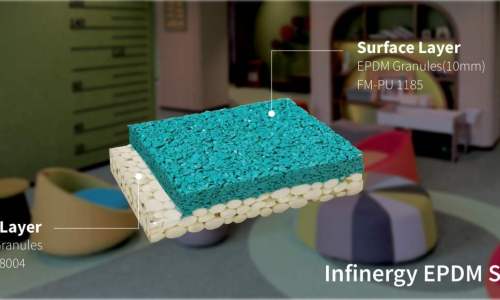


What Defines EPDM Rubber Granules Product Quality? A Granules Selection Guide for Wholesale
Choosing the right EPDM (Ethylene Propylene Diene Monomer) rubber granules is a critical decision for any wholesale buyer. The quality of these granules directly impacts the longevity, safety, and aesthetic appeal of the final surface, whether it's a playground, running track, or sports facility. This comprehensive guide will help you understand what truly defines product quality in EPDM granules, transforming your selection process from a guessing game into a confident, informed decision. We will delve deep into the nuances of color consistency, the science of material properties like density, and smart purchasing strategies that empower your EPDM wholesale granules selection.
Key Takeaways
- Color Quality is Paramount: True quality lies in batch-to-batch consistency and UV stability, not just the initial appearance. Inconsistent color can ruin a project's aesthetic, while poor UV resistance leads to rapid fading and degradation. Always request and test physical samples under natural light.
- Density Defines Durability: Understand the difference between true density and bulk density. Higher true density often indicates a higher EPDM polymer content and fewer fillers, leading to superior elasticity, tensile strength, and longevity. Bulk density affects coverage area and installation costs.
- A Strategic Buying Process is Your Best Tool: Never rely on price alone. A robust selection process includes vetting suppliers, demanding technical data sheets (TDS) and safety certifications (like EN 1177 or ASTM F1292), and performing simple on-site sample tests to verify quality claims.
- Not All EPDM is Created Equal: The term "EPDM granules" often refers to a compound of EPDM polymer, fillers (like calcium carbonate), oils, and pigments. A high percentage of virgin EPDM polymer (ideally over 20%) is crucial for performance. Be wary of suppliers who misrepresent recycled SBR as EPDM.
- Practical Testing Empowers Buyers: You don't need a lab to spot red flags. Simple tests like boiling granules to check for color bleeding, cutting them open to verify through-coloring, and performing a basic stretch-and-rebound test can reveal significant quality differences between samples.
Mastering Color Consistency: A Cornerstone of EPDM Rubber Granules Product Quality for EPDM Wholesale
When sourcing EPDM granules, color is often the first quality attribute that is noticed, but its importance goes far beyond simple aesthetics. For large-scale wholesale projects, color consistency is a non-negotiable hallmark of quality that impacts brand identity, project uniformity, and even safety. Inconsistent batches can lead to a patchy, unprofessional finish, creating costly disputes and rework. Furthermore, the color's ability to resist fading under UV exposure is a direct indicator of the granule's overall durability and the quality of its formulation.
The selection of raw materials and the manufacturing process are critical for achieving stable color. High-quality EPDM granules are thoroughly dyed, meaning the color is uniform throughout the entire particle, not just a surface coating. This ensures that even as the surface naturally wears over time, the color remains consistent. For applications like playgrounds and sports facilities, color is also functional, used to delineate safety zones, mark boundaries for games, or create engaging designs. Therefore, a supplier’s ability to guarantee color consistency across different production batches is a primary indicator of their quality control and manufacturing prowess.
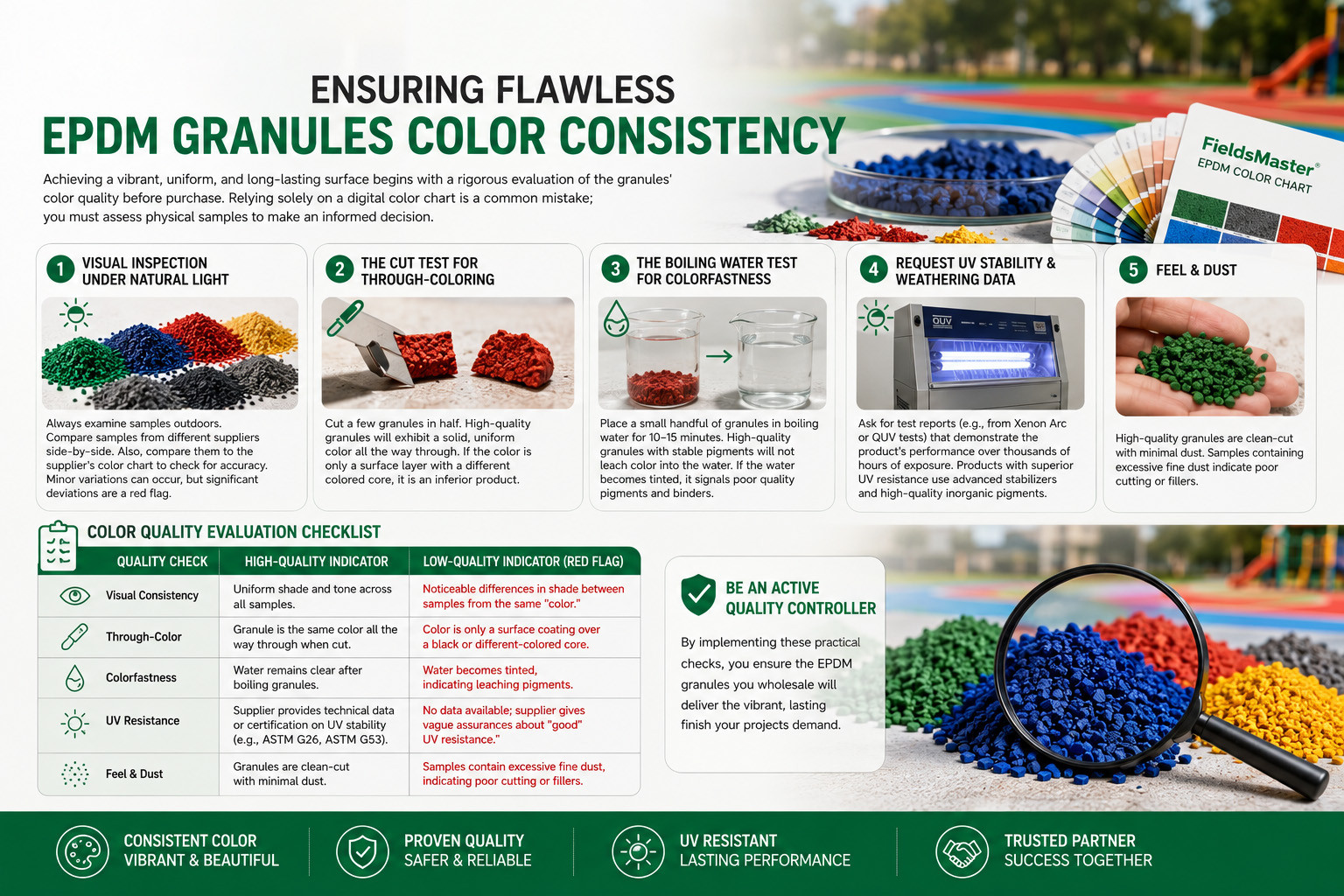
Ensuring Flawless EPDM Granules Color Consistency
Achieving a vibrant, uniform, and long-lasting surface begins with a rigorous evaluation of the granules' color quality before purchase. Relying solely on a digital color chart is a common mistake; you must assess physical samples to make an informed decision.
How to Test EPDM Granule Color Quality:
- Visual Inspection Under Natural Light: Always examine samples outdoors. Artificial lighting can alter color perception. Compare samples from different suppliers side-by-side. Also, compare them to the supplier’s color chart to check for accuracy. Minor variations can sometimes occur due to differences in pigment lots or granule texture, but significant deviations are a red flag.
- The Cut Test for Through-Coloring: A critical test of quality is to cut a few granules in half with a sharp utility knife. High-quality granules will exhibit a solid, uniform color all the way through. If the color is only a surface layer with a different colored core, it is an inferior product that will show its true colors (literally) as it wears down.
- The Boiling Water Test for Colorfastness: This simple test helps assess color bleeding. Place a small handful of granules in a heatproof container and pour boiling water over them. Let them sit for 10-15 minutes. High-quality granules with stable pigments will not leach color into the water. If the water becomes tinted, it signals poor quality pigments and binders, which will lead to fading and staining on the final surface.
- Request UV Stability and Weathering Data: Reputable manufacturers conduct accelerated weathering tests to prove their product's resistance to UV radiation, a major cause of color fading and material degradation. Ask for test reports (e.g., from Xenon Arc or QUV tests) that demonstrate the product's performance over thousands of hours of exposure. Products with superior UV resistance often use advanced stabilizers and high-quality inorganic pigments.
Color Quality Evaluation Checklist:
| Quality Check | High-Quality Indicator | Low-Quality Indicator (Red Flag) |
|---|---|---|
| Visual Consistency | Uniform shade and tone across all samples. | Noticeable differences in shade between samples from the same "color." |
| Through-Color | Granule is the same color all the way through when cut. | Color is only a surface coating over a black or different-colored core. |
| Colorfastness | Water remains clear after boiling granules. | Water becomes tinted, indicating leaching pigments. |
| UV Resistance | Supplier provides technical data or certification on UV stability (e.g., ASTM G26, ASTM G53). | No data available; supplier gives vague assurances about "good" UV resistance. |
| Feel & Dust | Granules are clean-cut with minimal dust. | Samples contain excessive fine dust, indicating poor cutting or fillers. |
By implementing these practical checks, you move from being a passive buyer to an active quality controller, ensuring the EPDM granules you wholesale will deliver the vibrant, lasting finish your projects demand.
Decoding Density & Bulk Density for Smart EPDM Wholesale Granules Selection
While color is a visible quality marker, the invisible properties of density are what truly determine the performance, durability, and long-term value of an EPDM surfacing project. For wholesale buyers, understanding the difference between the material's true density and its bulk density is crucial for making smart purchasing decisions. These two metrics influence everything from the physical resilience of the surface to the total material required for installation.
- True Density (or Material Density): This refers to the mass of the solid rubber material itself, per unit volume, excluding any air between the granules. It is an intrinsic property of the EPDM compound. A higher true density often correlates with a higher percentage of EPDM polymer and less low-density filler material (like calcium carbonate). Therefore, higher density is generally an indicator of better quality, suggesting superior tensile strength, elasticity, and wear resistance.
- Bulk Density: This measures the mass of a volume of loose granules, including the air-filled spaces between the particles. It is always lower than the true density. Bulk density is critical for logistics and installation planning, as it determines how much space a given weight of granules will occupy and, consequently, the coverage area you can achieve. A lower bulk density might mean more volume per bag, but it doesn't necessarily mean better quality.
A project's success hinges on granules with excellent physical properties like tensile strength and elongation at break, which are directly influenced by the quality of the EPDM compound. A surface made from low-density, high-filler granules may feel brittle, crack under stress, and degrade quickly, ultimately failing to provide the required safety and durability.
The Science Behind EPDM Granules Performance
The performance of an EPDM surface is a direct result of its chemical composition and physical structure. High-quality EPDM is a complex compound engineered for resilience. It begins with the selection of premium raw materials, including the base EPDM polymer, oils, fillers, and pigments, which are mixed and then vulcanized (typically using sulfur) to create a stable, cross-linked elastomer. This process is what gives the granules their durable, weather-resistant, and elastic properties.
Key Performance Indicators and How to Assess Them:
- Polymer Content: This is arguably the single most important factor. High-quality granules should have a significant EPDM rubber content, often recommended to be at least 20-22% by weight. Lower-cost alternatives frequently increase the ratio of inexpensive fillers, which compromises elasticity and durability. Always ask potential suppliers for the EPDM polymer percentage in their granules.
- Tensile Strength & Elongation: Tensile strength measures the force required to pull a material apart, while elongation at break measures how much it can stretch before snapping. High values in both indicate a tough, flexible material that can withstand heavy use and temperature fluctuations without cracking. While you can't measure this on-site, you can perform a simple "stretch test." High-quality granules will feel rubbery and resilient, whereas low-quality ones may feel brittle and snap easily. Ask for a Technical Data Sheet (TDS), which should list these properties.
- Hardness (Shore A): This measures the material's resistance to indentation. The hardness affects the anti-slip properties and the feel of the surface. It needs to be in a specific range—soft enough to provide cushioning but firm enough to be durable and provide good footing. This information should also be on the TDS.
Simple On-Site Density & Quality Assessment:
While precise measurements require lab equipment, you can get a good comparative sense of quality with these methods:
- The Weight Comparison: Take two identical containers and fill them to the same level with samples from different suppliers. The sample that weighs significantly more likely has a higher true density and, therefore, a higher polymer content.
- The Compression Test: Squeeze a handful of granules tightly. High-quality, high-polymer granules will compress and then rebound to their original shape. Low-quality granules will feel "crunchy," may not rebound well, or may even crumble under pressure.
Typical Properties: High vs. Low Quality
| Property | High-Quality EPDM Granules | Low-Quality EPDM Granules |
|---|---|---|
| EPDM Polymer Content | Typically >20% | Often <15%, high filler content |
| Density | Higher (e.g., ~1.5-1.6 g/cm³) | Lower (due to more low-density fillers) |
| Feel | Elastic, rubbery, resilient | Brittle, chalky, or overly soft |
| Tensile Strength | High (e.g., >3.0 MPa) | Low, prone to tearing |
| Elongation at Break | High (e.g., >400%) | Low, snaps with little stretching |
| Data Availability | Supplier provides a detailed TDS with all key specs. | Vague specifications, missing data, or unwilling to provide a TDS. |
By focusing on these scientific properties, wholesale buyers can look past the surface-level appearance and price, selecting granules that guarantee superior performance and a longer lifespan for the finished project.
Empowering Your EPDM Wholesale Granules Selection: Practical Steps for Assured Product Quality
Making an informed wholesale purchase of EPDM granules requires more than just comparing prices. It demands a strategic approach to sourcing and verification to ensure you receive a product that delivers on its promises of durability, safety, and aesthetics. Empowering your selection process means establishing a clear set of criteria, asking the right questions, and knowing how to verify the answers you receive. This proactive stance protects your investment, your project's integrity, and your reputation.
The first step is to move beyond the sample and assess the supplier's reliability and quality control systems. A reputable manufacturer will have standardized processes and continuous monitoring to guarantee consistency in color, grain size, and physical properties from one batch to the next. They should be transparent about their materials and willing to provide documentation that substantiates their quality claims. Look for suppliers with a proven track record and positive client testimonials. While exploring different vendors, you can benchmark their product specifications against a high standard by visiting our product page{:target='_blank'} for a reference on quality.
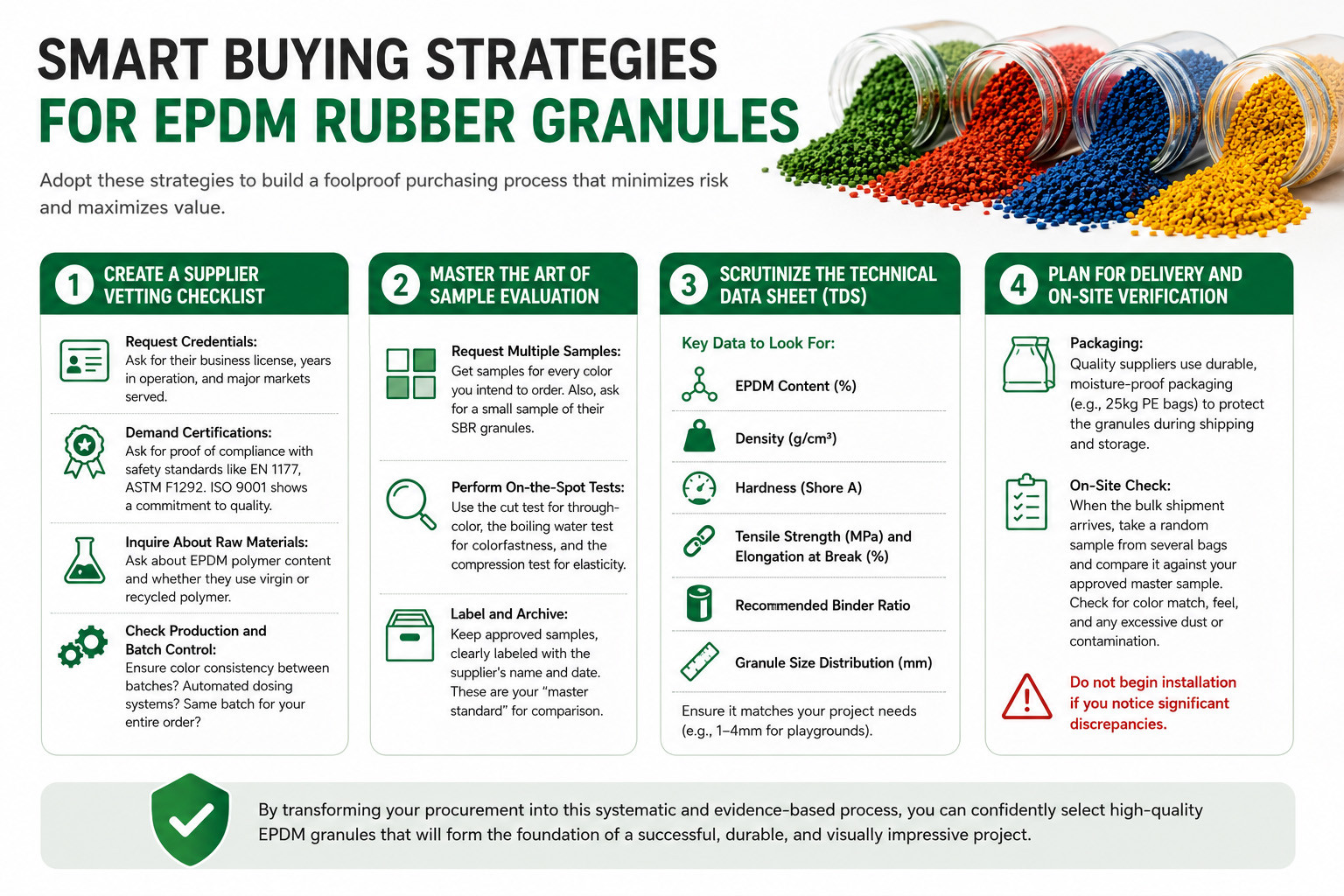
Smart Buying Strategies for EPDM Rubber Granules
Adopt these strategies to build a foolproof purchasing process that minimizes risk and maximizes value.
1. Create a Supplier Vetting Checklist: Before committing to a large order, thoroughly evaluate potential suppliers.
- Request Credentials: Ask for their business license, years in operation, and major markets served. Experienced manufacturers with a global reach are often more reliable.
- Demand Certifications: Quality granules should meet international standards. Ask for proof of compliance with safety standards like EN 1177 (Impact Attenuation) or ASTM F1292 (Shock Absorption). ISO 9001 certification indicates a commitment to quality management systems.
- Inquire About Raw Materials: Ask directly about the EPDM polymer content and whether they use virgin or recycled polymer. A transparent supplier will provide this information. Be cautious of suppliers who are evasive or provide vague answers.
- Check Production and Batch Control: How do they ensure color consistency between batches? Do they use automated dosing systems? Can they provide material from the same production batch for your entire order? This is crucial for large projects to avoid color mismatches.
2. Master the Art of Sample Evaluation: A sample is your most powerful evaluation tool.
- Request Multiple Samples: Get samples for every color you intend to order. Also, ask for a small sample of their SBR granules if you plan to use them for a base layer.
- Perform On-the-Spot Tests: Use the hands-on tests described earlier: the cut test for through-color, the boiling water test for colorfastness, and the compression test for elasticity.
- Label and Archive: Keep approved samples, clearly labeled with the supplier's name and date. These become your "master standard" to compare against the bulk delivery when it arrives.
3. Scrutinize the Technical Data Sheet (TDS): A TDS is a non-negotiable document. A supplier unwilling to provide one should be immediately disqualified.
- Key Data to Look For:
- EPDM Content (%): The higher, the better.
- Density (g/cm³): For material quality comparison.
- Hardness (Shore A): To ensure proper firmness.
- Tensile Strength (MPa) and Elongation at Break (%): For durability.
- Recommended Binder Ratio: This is essential for correct installation.
- Granule Size Distribution (mm): Ensure it matches your project needs (e.g., 1-4mm for playgrounds).
4. Plan for Delivery and On-Site Verification: Your diligence shouldn't end once the order is placed.
- Packaging: Quality suppliers use durable, moisture-proof packaging (e.g., 25kg PE bags) to protect the granules during shipping and storage.
- On-Site Check: When the bulk shipment arrives, immediately take a random sample from several different bags and compare it against your approved master sample. Check for color match, feel, and any excessive dust or contamination. Do not begin installation if you notice significant discrepancies.
By transforming your procurement into this systematic and evidence-based process, you can confidently select high-quality EPDM granules that will form the foundation of a successful, durable, and visually impressive project.
Frequently Asked Questions (FAQ)
Q1: What is the ideal EPDM polymer content I should look for? A: For high-quality, durable surfaces, you should look for EPDM granules with a polymer content of at least 20-22%. This ensures the granules have excellent elasticity, tensile strength, and resistance to weathering. Products with a lower polymer percentage often contain more fillers like calcium carbonate, which can make the surface brittle and reduce its lifespan. Always ask for the polymer content and verify it on the Technical Data Sheet (TDS).
Q2: How does weather and UV exposure affect EPDM granule quality over time? A: Weather and UV radiation are the primary enemies of outdoor rubber surfaces. Prolonged exposure can cause two main issues: color fading and material degradation. Poor quality pigments will fade quickly, while the rubber polymer itself can become hard and brittle, leading to cracks. High-quality EPDM is specifically formulated with UV stabilizers and high-performance, weather-resistant pigments to combat these effects, ensuring the color remains vibrant and the material stays flexible for many years. Some manufacturers even offer different binders, like aliphatic polyurethane, which are more UV stable and prevent yellowing.
Q3: Can I mix EPDM granules from different suppliers on the same project? A: It is strongly advised not to mix granules from different suppliers, even if the color appears to be the same. Each manufacturer has a unique formulation, including different pigments, polymers, and curing processes. Mixing them can result in noticeable shade variations, inconsistent physical properties, and potential bonding issues with the polyurethane binder. For a uniform and reliable finish, always source all granules for a single, continuous surface from the same supplier and, if possible, from the same production batch.
Q4: What are the immediate red flags of poor quality EPDM granules upon delivery? A: When your shipment arrives, there are several warning signs you can spot immediately.
- Color Mismatch: The color of the delivered granules does not match your approved sample.
- Excessive Dust: A large amount of fine powder in the bags indicates poor manufacturing or the breakdown of low-quality fillers. This can weaken the bond with the binder.
- Contamination: Look for foreign objects, clumps, or oversized particles in the bags.
- Strong Chemical Odor: While all EPDM has a mild scent, an unusually strong or pungent chemical odor can indicate the use of low-grade raw materials or improper curing.
- Damaged Packaging: Torn or wet bags suggest poor handling and can lead to contaminated or moisture-affected granules.
Q5: How does the granule size affect the final surface? A: Granule size significantly impacts both the look and feel of the finished surface. Common sizes range from 0.5mm to 4mm.
- Fine Granules (e.g., 0.5-1.5mm): These create a smoother, more compact surface. They are often used for detailed graphic inlays, logos, or indoor applications where a less textured finish is desired.
- Standard Granules (e.g., 1-4mm): This is the most common size for playgrounds and running tracks. It provides an excellent balance of cushioning, durability, and porosity for water drainage. The size can also slightly affect the perception of color, as light reflects differently off finer or coarser textures.
Conclusion
Making an informed decision when purchasing EPDM rubber granules for wholesale is absolutely vital for the success and longevity of any surfacing project. The quality of these small particles has a massive impact on the final outcome. By shifting your focus from price alone to a comprehensive evaluation of critical quality aspects—namely color consistency, material density, and core performance properties—you can confidently guarantee durable, safe, and attractive results for your clients.
To ensure excellence, you must adopt a strategic purchasing process. This involves demanding transparency from suppliers, meticulously examining physical samples, and understanding the data provided in technical sheets. Remember that the best suppliers are partners in quality, providing products that are not just aesthetically pleasing but are scientifically engineered for performance with superior UV resistance, high polymer content, and batch-to-batch consistency.
We are dedicated to being such a partner, providing top-quality EPDM granules that help your projects shine and achieve lasting product quality. Armed with the knowledge from this guide, you are now better equipped to navigate the market and select materials that will stand the test of time. We encourage you to use these insights in your next project, share this guide with your colleagues, and continue to champion quality in every surface you create.